
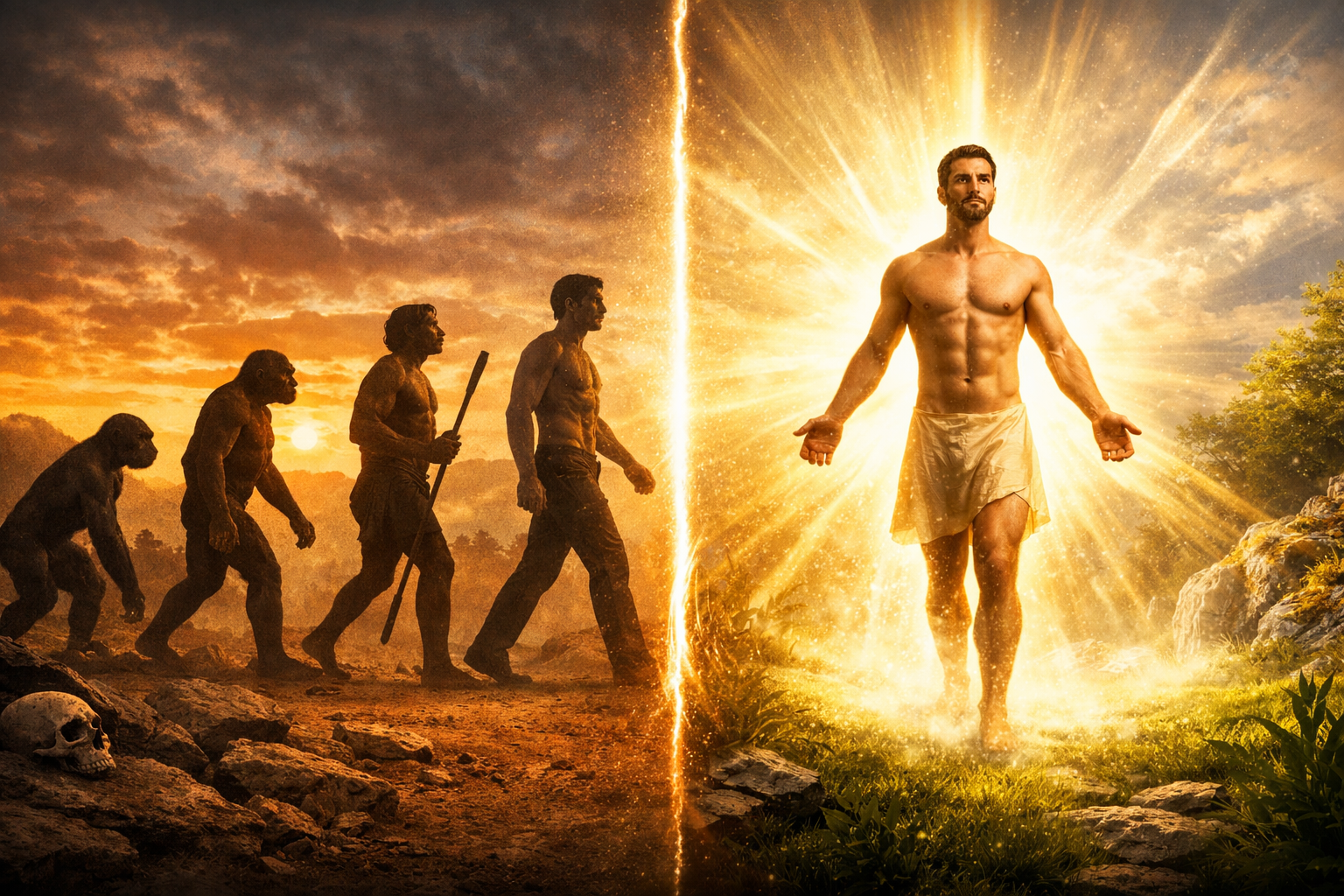
My atheist friends often present Genesis 1 as the ultimate proof text that God doesn’t exist. It goes like this:
1) The Bible says God created the universe in 6 days, 6,000 years ago.
2) We clearly observe with our eyes that the universe appears much older than this.
3) Therefore the Bible must be wrong, and it is not a Word from God.
They are absolutely correct about (1) and (2)—but wrong about (3). Because this assumes that what we see, experience, and reason are the only things that determine what is real.
1) The Bible says God created the universe in 6 days, 6,000 years ago
The Bible does say God created the universe in 6 days, 6,000 years ago. And while there’s a few points of the Hebrew in Genesis 1-2 that require careful reading, you don’t need to know any Hebrew to understand the plain sense meaning of Exodus 20:11:
For in six days the LORD made heaven and earth, the sea, and all that is in them, and rested on the seventh day. (Exodus 20:11)
Even just from a reading of the English of that verse, it’s clear: the Bible unambiguously teaches that God made the universe in 6 days.
2) We clearly observe with our eyes that the universe appears much older than this
The Bible tells us things about creation that did not fit what even the first readers of Genesis could see with their eyes.
Adam was created in Genesis 1:27 and 2:7 as a mature adult human being. That very same day he talked with God (Genesis 2:15-17), named all the animals (2:18-21), and got married (Genesis 2:22-25). No people group—no matter how ancient—would have seen or experienced a man appearing instantly mature. It does not fit the ordinary human experience of any culture.
But not just that: in the Garden of Eden a snake talks (Genesis 3:1). There’s simply no culture on earth where that’s ever been a normal observed reality.
Even for the very first readers of Genesis, what is being described does not fit their observations, experiences, and natural reason.
3) But! This does not mean the Bible must be wrong—because it is the Word of God
Here is how God’s Word works:
God’s Word tells us what something is.
Our senses tell us what it looks like.
Faith refuses to let ‘looks like’ redefine ‘is’.
This is not just about creation—it is how the whole Christian faith works. The Bible tells us this in several places:
Now faith is the assurance of things hoped for, the conviction of things not seen. For by it the people of old received their commendation. By faith we understand that the universe was created by the word of God, so that what is seen was not made out of things that are visible. (Hebrews 11:1-3)
The book of Hebrews describes faith as assurance of what God’s Word says—even though this is not seen.
we walk by faith, not by sight. (2 Corinthians 5:7)
Here the apostle Paul explains that Christians are those who live by what they are assured is true from God’s Word, rather than what they see.
But, while we receive God’s Word as he speaks—even when it goes beyond or against what we can see—we are still free to describe and work within the world as it appears to us in matters of ordinary life and vocation. God made the world we see (Genesis 1)—and he made it with wisdom:
The LORD by wisdom founded the earth; by understanding he established the heavens; (Proverbs 3:19)
So, the Bible tells us the world is stable, ordered, and intelligible. We are meant to live and work within it as it appears to us. The wisdom literature (Psalms, Proverbs, Job, Ecclesiastes) even encourages us to look at the creation and draw conclusions for our lives from it.
So, because of this freedom, faith does not abolish sight (2 Corinthians 5:7). But where faith and sight seem to conflict, we do not resolve the tension by reinterpreting the Word, but by trusting it.
This occurs in every part of the Christian Gospel, but we see it most clearly in the Lord’s Supper:
Christ says, “This is my body.”—His Word makes this reality.
Our senses still perceive bread—and we handle it and chew it as bread.
We confess that it is both body and bread without explaining it away or reducing one to the other.
In the same way, we confess that God made the world in 6 Days:
God says what happened. We receive it as true.
We also observe, study the world, and build technology as it appears.
We don’t force a synthesis.
We don’t override the Word.
This also shows something deeper: faith can never be created—or even prepared for—by observation, experience, or reasoned logical argument. My atheist friends therefore often ask me “Why would I have faith?”
And the answer is: because God gives us faith as a gift. God’s mercy and forgiveness are objective realities. They exist outside of our experience. Jesus:
…entered once for all into the holy places, not by means of the blood of goats and calves but by means of his own blood, thus securing an eternal redemption. (Hebrews 9:12)
This happened outside our sight and beyond what we could discover by experience and reason—but it determines what is true for us now. This eternal redemption is what God gives to us through his Word. Faith is the assurance that we have it. That’s why faith itself is a supernatural gift.
And that’s why God gave you the church—as the place where you can receive this supernatural forgiveness and assurance from outside your experience. Beyond anything you can see. Come along in person any Sunday, or join online on Wednesday from anywhere:


Leave a Reply