

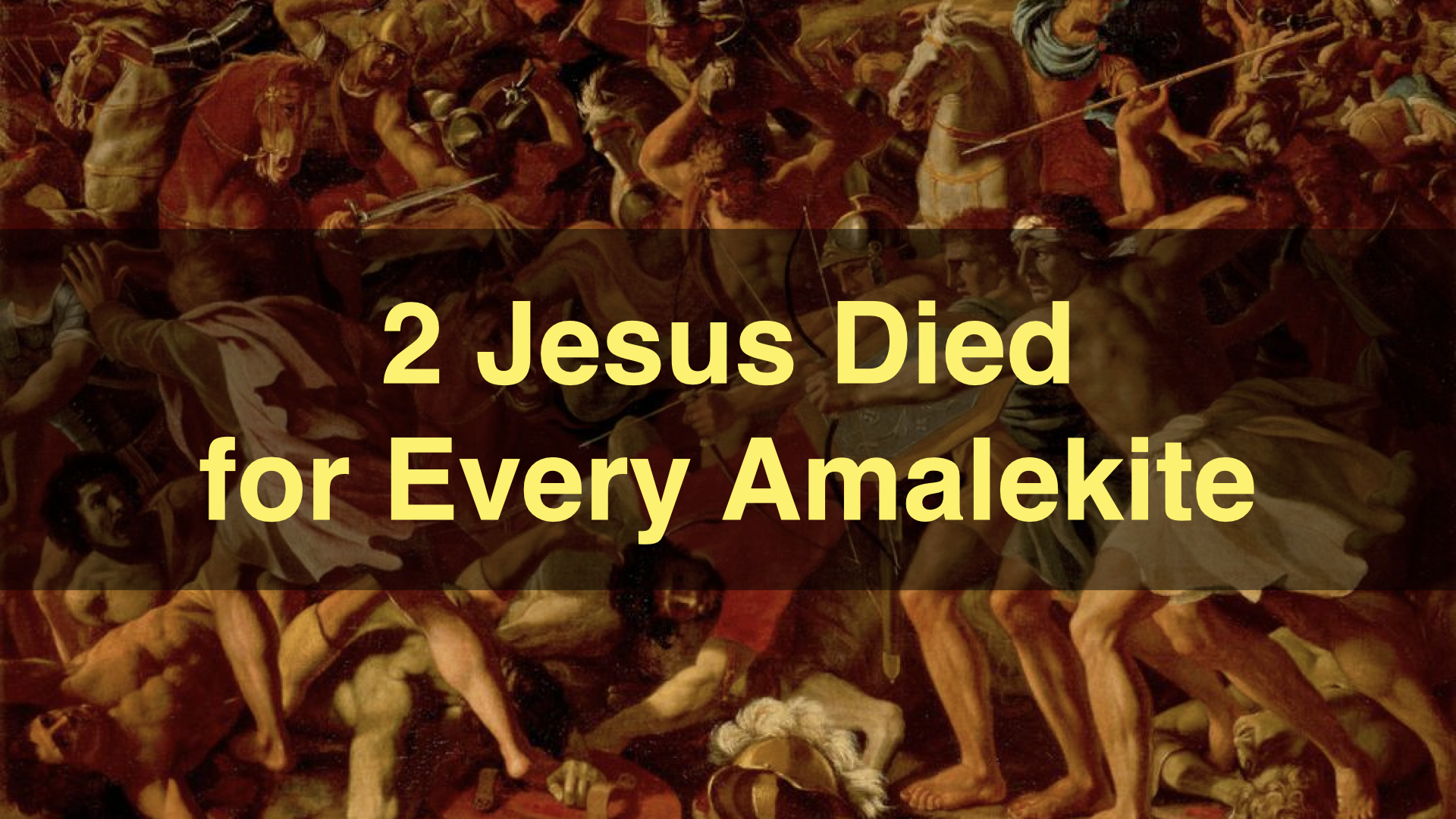
God commanded ancient Israel to commit genocide. You and I are rightly troubled by that.
In our first post, we looked squarely at the most clear and difficult passage in the whole Bible on this, 1 Samuel 15:1-3, where God commands Saul to slaughter the Amalekites: every “man and woman, child and infant, ox and sheep, camel and donkey.”
We saw that all forms of judgment are an outcome of God’s Law in response to human sin—but that this Law was not given as a revelation of God’s heart toward sinners.
God is judge of the whole world, so must execute justice. He is the judge. We are not, and so we are not able to evaluate his decisions.
The Law and its consequences are terrifying, and so can never give us assurance that God is a good judge, and that we can trust him to judge with good decisions.
It is the Gospel, not the Law, that reveals God’s heart toward us, through which he gives us trust in his goodness. That’s what this second post will focus on today.
Human words don’t help
The Law reveals something about God to us, but doesn’t reveal God’s heart toward sinners.
In contrast our words, speculations and thoughts about God are able to reveal nothing without him speaking to us. God tells us that every human being has his Law written on our hearts (Romans 2:15). So, at best, if we think deeply, we can discern something about God’s judgment against sin, which the Bible calls his “wrath” (Romans 1:18). But this doesn’t reveal who God is personally.
God warns us not to speculate about him or go beyond what he has told us. He has revealed himself to us in his Word, so that we can have a right relationship with him:
The secret things belong to the LORD our God, but the things that are revealed belong to us and to our children forever, that we may do all the words of this law. (Deuteronomy 29:29)
you may learn by us not to go beyond what is written (1 Corinthians 4:6)
Yet, many people today do precisely this. They speculate about God, claiming that as long as their starting point is scripture, whatever seems logical to them about God must be true. But God himself tells us this is wrong—we are unable to understand him from our own thoughts:
For as the heavens are higher than the earth,
so are my ways higher than your ways
and my thoughts than your thoughts. (Isaiah 55:9)
Oh, the depth of the riches and wisdom and knowledge of God! How unsearchable are his judgments and how inscrutable his ways! “For who has known the mind of the Lord, or who has been his counsellor?” “Or who has given a gift to him that he might be repaid?” (Romans 11:33-35)
There is a very simple application of all of this to the difficult and painful issue of genocide in the Old Testament:
Don’t make up explanations the Bible doesn’t explicitly give you.
No matter how logical, or persuasive, or compelling your explanation may be: if God doesn’t say it, it is not a revelation of him.
Don’t try to defend God by going beyond what he has revealed, because this relocates faith from God’s Word to human reasoning (which is not true faith: John 2:23-25), and they often try to defend God by inventing hidden information.
One common speculation is to say something like:
“God saw that the children would grow up to become wicked.”
The problem is, we don’t know that. Scripture doesn’t actually say that. And it is the exact opposite of what God himself says in the Bible about how he deals with the Amalekites justly. God explicitly doesn’t judge them before their time, before they’ve actually committed a crime:
And they shall come back here in the fourth generation, for the iniquity of the Amorites is not yet complete.” (Genesis 15:16)
Another speculation is to say something like:
“All the children went to heaven. Death was actually salvation for them.”
But, the Bible nowhere universally promises this. You cannot build certainty where God has not spoken. It also risks making mass killing sound spiritually beneficial—which is never an explanation given anywhere in the Bible.
The Bible explicitly tells us in many places about how God brings salvation and forgiveness to people. God revealed through Moses that he gives life through his Word:
man does not live by bread alone, but man lives by every word that comes from the mouth of the LORD. (Deuteronomy 8:3)
And so, the prophets preached that God’s Word is the means by which he gives his grace:
For as the rain and the snow come down from heaven and do not return there but water the earth, making it bring forth and sprout, giving seed to the sower and bread to the eater, so shall my word be that goes out from my mouth; it shall not return to me empty, but it shall accomplish that which I purpose, and shall succeed in the thing for which I sent it. (Isaiah 55:10-11)
And he said to me, “Son of man, can these bones live?” And I answered, “O Lord GOD, you know.” Then he said to me, “Prophesy over these bones, and say to them, O dry bones, hear the word of the LORD. Thus says the Lord GOD to these bones: Behold, I will cause breath to enter you, and you shall live. (Ezekiel 37:3-5)
Therefore, if infants, or even unborn children, have heard the Word of the Gospel, we have good reason to hope that they might have spiritual life. Because God promises generally to bring life through his Word.
And what’s more, God has promised that all those who receive baptism receive the Holy Spirit, who is the person that actually gives this life to us:
And Peter said to them, “Repent and be baptized every one of you in the name of Jesus Christ for the forgiveness of your sins, and you will receive the gift of the Holy Spirit. (Acts 2:38)
So, if infants have been baptised, then we can be certain they have the Holy Spirit and so have spiritual life—because God explicitly promises this.
But outside of this means of grace (his Word of the Gospel) we have no promises from God. So, we should not speculate about the eternal salvation of infants who have not heard the Word. And we especially shouldn’t invent promises that God has not given.
This undermines the promises God really has given, and encourages people to trust in the speculative and uncertain opinions of human beings like you and me.
But God’s Word does help
We don’t need to speculate, because God does say: he assures us that he is the judge of the world and that he is good:
Shall not the Judge of all the earth do what is just? (Genesis 18:25)
And God’s justice—called in the Bible his righteousness—is not ultimately seen in displays of power or judgments of the Law, but in Jesus dying for you and me on the cross to bring us forgiveness (Romans 3:21-22). The Law points to this act of mercy when it talks about God as judge:
The Rock, his work is perfect, for all his ways are justice. A God of faithfulness and without iniquity, just and upright is he. (Deuteronomy 32:4)
He will judge the world in righteousness, and the peoples in his faithfulness. (Psalm 96:13)
There are many, many difficult decisions in governing the universe. There are infinite factors to consider, and billions of calculations involved.
I don’t even know how best to organise my tax.
So, I’m definitely not in the position to evaluate how God is making all those judgments.
But, what God’s Word does assure me of is this: the kindest person in the universe is making the most difficult decisions. That’s what the cross reveals—that’s what we see when we look at Jesus.
Because when we look at Jesus on the cross, we see: The judge of all the earth gave his own life for every infant who dies.
I don’t know 99.9% of the details. But I do know this. When the God who says to Saul “Now go and strike Amalek and devote to destruction all that they have. Do not spare them, but kill both man and woman, child and infant…” is the God who became man as Jesus Christ.
And Jesus died for every Amalekite: for every man, for every woman, for every child, and for every infant.
No human judge has ever done this.
I can’t reason from this and speculate about what happened to every infant, and what their eternal outcome is. But I can say with confidence that the best person to make decisions about the judgment and eternal destiny of an infant, is the person who gave his life for that infant.
As judge of the whole world, God has to make some extremely horrible decisions. So, who is this God? The prophet Isaiah tells us:
He was despised and rejected by men, a man of sorrows, and acquainted with grief… he has borne our griefs and carried our sorrows; yet we esteemed him stricken, smitten by God, and afflicted. But he was pierced for our transgressions; he was crushed for our iniquities;… and the LORD has laid on him the iniquity of us all. (Isaiah 53:3-8)
And it is only because of this—as I look at the judge of the world hanging on the cross for every single one of us—that I trust him.
So when someone says to me: “What about genocide in the Old Testament?”
Here’s how I reply:
God is the judge of the whole earth—I’m not.He himself died for all those people—I didn’t.That’s why I’m glad he’s the one who has to make these awful decisions, not me.
I trust him.
Whoever you are reading this: Jesus died for you too. Events like this recorded in the Old Testament are really heavy.
And our lives today also are full of heavy things too, even if not as extreme. Each of us our lives experiencing all sorts of injustices and sufferings that we can’t explain. Speculation doesn’t help. But even in the midst of them, the judge of the world wants to assure you that he died for you, has forgiven you, and loves you unconditionally.
That assurance—that faith—comes only as we hear his Word of the Gospel. And this is why he gave you the church. As the place where you know you’ll receive that Gospel.
Come and receive that Gospel with us as we gather together around God’s Word each week:
- In person in Manchester every Sunday.
- Online from anywhere every Wednesday.