
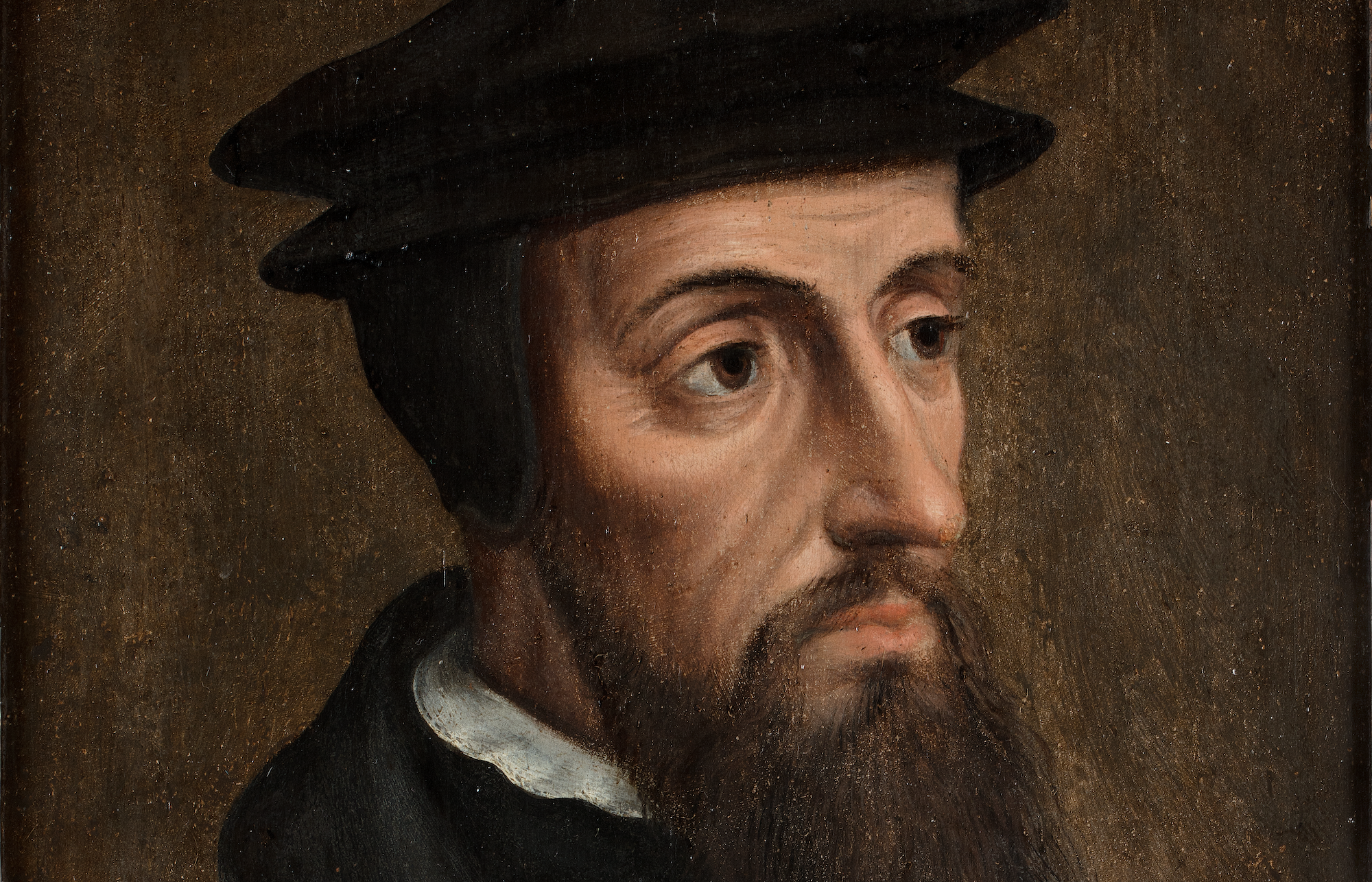
John Calvin was confused about predestination. As a result, many Christians today are also confused about it, and believe God predestined some people for damnation.
This is serious. Because that idea is terrifying. It would mean Jesus didn’t die for everyone. It would mean the most important thing in your life is not to look at Jesus to reveal God’s genuine heart toward you, but instead to try and find a way to work out what God’s hidden decree about you before time began actually said.
But be assured of this: not only does that go beyond what the Bible actually says, it disagrees with what it explicitly says.
God wants all people to be saved.
Jesus died for the sins of the whole world so that all people would be saved.
God gives and applies this salvation freely—this is entirely from him.
Those who resist it do so, not because of God, but because they resist and reject him in unbelief—this is entirely from them.
God is solely responsible for salvation. We are solely responsible for damnation.
Calvin’s confusion was to go beyond the Bible—and so inadvertently contradict it—by claiming God’s decision is ultimately responsible for damnation as well.
Do you want God to unconditionally love you? He does.
Do you want Christ to have died for your sins? He has.
Do you want to be finally saved on the last day? You will be, purely because of Jesus—cling to him alone, and don’t look back or look away.
This is the first of a series of posts where we look at Calvin’s description of predestination in Book 3, chapter 21 of his work: The Institutions of the Christian Religion.
Now, Calvin writes four whole chapters on this topic. If I did a series of posts covering all of them in detail, it would take me many weeks. So, this series will just focus on his key chapter that defines predestination. If it helps people, then I will write more on Calvin’s other chapters another time.
In this first post I will just do two things: describe what the Bible says about predestination, and then how Calvin has misunderstood it.
Part 2 will step through book 3 chapter 21 of Calvin’s Institutes and show how, in that chapter, Calvin’s confusion arises because he does not obey his own rules about how to read the Bible.
The rest of the series will look at the parts of the Bible Calvin uses and quotes in chapter 21 and explain what they really say.
Who Are You Talking About?
First, just real quick, if you’ve got this far in the post and you have no idea who John Calvin is or why he matters, then well done for your patience!
Briefly, back in the 16th century, a man called Martin Luther publicly pointed out that the Roman Catholic church taught many things that disagreed with the Bible. He called all Christians to only believe, teach and confess what the Bible itself says about God.
Very quickly afterwards many other people started also criticising the Roman Catholic church—but they did not agree with Luther about the Bible.
These other people believed that the Bible says many things, but that the words mean something different. Or that when the Bible says certain things, what we should believe is something more (the Westminster Confession of Faith called this “good and necessary consequence”).
John Calvin was one of these people who criticised the Roman Catholic church, but did not agree with Luther about the Bible.
Calvin claimed the Bible says things like God “desires all people to be saved and to come to the knowledge of the truth” (1 Timothy 2:4), but what it means is that while God wills (i.e. wants) some people to be damned in one sense, he wills (i.e. wants) them to be saved in another sense.
Calvin also claimed that because the Bible says things like “In love he predestined us for adoption to himself as sons through Jesus Christ” (Ephesians 1:4-5), we should believe more than what is actually said: because it seems so logical to us that to predestine some for life means he must have predestined everyone else for death.
What Calvin believed and taught is important, because he has become one of the most influential Christian writers for the last 500 years.
Calvin’s “Institutes of the Christian Religion” is a major work in four books, and a big reason he has had such influence. That’s why we’re looking at a chapter from that work in this series of posts.
The Bible Teaches Predestination to Life
Here’s what the Bible says about predestination:
- God the Father does everything purely because of his fatherly, divine goodness and compassion, not because of any merit or worthiness of our own. (Ephesians 2:8-9)
- The Father genuinely loves all people, and created all people to bring them to a saving knowledge of his Son, Jesus. (John 3:16)
- The Father’s genuine desire for the salvation of all people is seen in Jesus dying for the sin of all people, to justify all people in Jesus. (1 John 2:2)
- The Gospel is the universal declaration that God has forgiven everyone in Jesus. God calls all people to trust it. This universal call is earnest and not a deception. (Mark 16:15-16)
- Through the universal declaration that Jesus died for all people, the Holy Spirit gives people trust that Jesus died for them. (Romans 10:17)
- The Father chose people in Jesus to give them this trust and preserve them in it. (Ephesians 1:4-5)
- This election in Christ is based on God’s grace, not foreseen faith or merit. (Romans 11:5-6)
- This election is revealed in Jesus alone, I should not speculate on it outside of Jesus revealed in the Word. (John 6:40)
- Paradoxically, although the Father chose some people for salvation, the Bible never says he chose the rest for damnation. So as logical as that conclusion may feel to us: we should not believe and teach it. (Deuteronomy 29:29)
- The Father chose no one for condemnation, and does not providentially work to prevent the salvation of anyone. (Ezekiel 33:11)
- It is purely because of God’s grace that some people trust Jesus and are saved. (Philippians 1:29)
- It is purely because of our hardness of heart and unbelief that some people reject Jesus, resist the Spirit and are not saved. (Matthew 23:37)
For more detail, you can read a concise summary of what the Bible, and therefore what the Book of Concord, teaches about predestination in section 24 of the Confession of our church.
Calvin’s Confusion about Predestination in Institutes 3.21
In tomorrow’s post, I will give an outline of Institutes 3.21, and show how it is that Calvin does not follow his own method for reading the Bible. Here, I will just describe simply how he departs from what the Bible actually says about predestination.
Calvin Says Damnation is Ultimately Down to God, Not Us
Calvin repeatedly locates the ultimate reason for damnation in God’s secret decree, not in the responsibility of human beings:
By predestination we mean the eternal decree of God, by which he determined with himself whatever he wished to happen with regard to every man. All are not created on equal terms, but some are preordained to eternal life, others to eternal damnation; and, accordingly, as each has been created for one or other of these ends, we say that he has been predestinated to life or to death. (Calvin’s Institutes 3.21.5)
Only once in the chapter, when talking about descendants of Abraham who do not inherit the line of promise, does Calvin make a crucial observation about all the passages that talk about them:
I admit that it was by their own fault Ishmael, Esau, and others, fell from their adoption (Calvin’s Institutes 3.21.6)
However, Calvin does not apply this observation to anything he claims in the chapter, or discuss it further. Later in the paragraph he again ultimately grounds the fall of these in God’s choice, not theirs:
…in the election of the whole nation, God had already shown that in the exercise of his mere liberality he was under no law but was free, so that he was by no means to be restricted to an equal division of grace, its very inequality proving it to be gratuitous. (Calvin’s Institutes 3.21.6)
The whole chapter is framed in this way: as symmetrical. Both salvation and damnation are ultimately God’s decision and even action:
…[God] gives to some what he denies to others. (Calvin’s Institutes 3.21.1)
This is not the way the Bible speaks. Even in Romans 9-11—the one passage that is most often claimed to support Calvin’s views—Paul is always careful never to ultimately ascribe damnation to God’s will or decision, but only to human unbelief.
But if some of the branches were broken off, and you, although a wild olive shoot, were grafted in among the others and now share in the nourishing root of the olive tree, do not be arrogant toward the branches. If you are, remember it is not you who support the root, but the root that supports you. Then you will say, “Branches were broken off so that I might be grafted in.” That is true. They were broken off because of their unbelief, but you stand fast through faith. So do not become proud, but fear. (Romans 11:17-20)
Paul here carefully avoids exactly the kind of pride that Calvin wants to avoid by ascribing salvation purely to God—but simultaneously explains those who fall away as doing so purely because of their unbelief.
Romans 9-11 will be explained in more detail in later posts.
Calvin Describes Damnation as Pleasing God
Calvin says it is God’s “pleasure” to doom some people to destruction:
We say, then, that Scripture clearly proves this much, that God by his eternal and immutable counsel determined once for all those whom it was his pleasure one day to admit to salvation, and those whom, on the other hand, it was his pleasure to doom to destruction. (Calvin’s Institutes 3.21.7)
This is the explicit opposite of what God himself says is his pleasure:
Say to them, As I live, declares the Lord GOD, I have no pleasure in the death of the wicked, but that the wicked turn from his way and live; (Ezekiel 33:11)
And praying for the salvation of all people is “pleasing” to God, precisely because this is what God wants:
This is good, and it is pleasing in the sight of God our Savior, who desires all people to be saved and to come to the knowledge of the truth. (1 Timothy 2:3-4)
Calvin Claims God’s Eternal Decision Keeps The Gospel Back from Some People Hearing It
Calvin doesn’t just ascribe people’s unbelieving response to the Gospel to God’s eternal decree, but even the scope of how widely it is preached:
The covenant of life is not preached equally to all, and among those to whom it is preached, does not always meet with the same reception. This diversity displays the unsearchable depth of the divine judgment, and is without doubt subordinate to God’s purpose of eternal election. (Calvin’s Institutes 3.21.1)
In contrast, Jesus explicitly tells the apostles to preach the Gospel indiscriminately to the whole creation:
Go into all the world and proclaim the gospel to the whole creation. (Mark 16:15)
But, according to this explanation by Calvin, God’s election is providentially working to ensure the Gospel is not preached equally to all—even though Jesus commanded the church to do this. This is not how the doctrine of election is used in Acts 18:10, where it is a reason to keep evangelising, even when no fruit is seen.
Romans 1 does tell us that one way God’s judgment is seen in the world is by him withdrawing himself (which from context means withdrawing his Word). But this is a response to human sin and rejection of him:
Therefore… (v. 24); For this reason… (v. 26); And since they did not see fit… (v. 28)
And even this consequence of the Law is not an end in itself, but Paul explains in chapter 3 it has the purpose of leading people to the Gospel:
whatever the law says it speaks to those who are under the law, so that every mouth may be stopped, and the whole world may be held accountable to God… But now the righteousness of God has been manifested apart from the law, although the Law and the Prophets bear witness to it—the righteousness of God through faith in Jesus Christ for all who believe. (Romans 3:19, 21-22)
Calvin Even Makes the Damnation of Others Partly a Ground for Christian Hope
Calvin is right that God’s election is given to Christians as a basis for hope and confidence. However, because he has redefined election to mean not just election to life, but also reprobation to death, he explicitly says that the fact that God has passed over and reprobated some for damnation is supposed to be a grounds for Christian confidence:
We shall never feel persuaded as we ought that our salvation flows from the free mercy of God as its fountain, until we are made acquainted with his eternal election, the grace of God being illustrated by the contrast—viz. that he does not adopt all promiscuously to the hope of salvation, but gives to some what he denies to others. (Calvin’s Institutes 3.21.1)
But in contrast, Paul rightly opens his letter to Timothy by saying:
Christ Jesus our hope (1 Timothy 1:1)
This is the message of the Gospel Christians have received.
Our hope is Jesus Christ. Our hope is not that others have been damned. Final judgment is an encouragement to suffering Christians only in this sense: evil will be defeated and never be able to pass through the gates to ruin the eternal city Christ will bring. Paradoxically:
its gates will never be shut by day (Revelation 21:25)
And yet:
nothing unclean will ever enter it, nor anyone who does what is detestable or false, but only those who are written in the Lamb’s book of life. (Revelation 21:27)
There will be perfect peace and security.
Christian hope and security truly is grounded in God’s election: which is positive election to life in Christ—not in the negative election of others to damnation outside of Christ.
This Christ is the person God wants you to look at, and so be assured that you are elect. The elect are those who trust Christ died for them.
How do you know Christ died for you? Because he died for all people. As you hear the Gospel declare this, the Spirit gives you this assurance, and you receive all its benefits. Christ himself promised to be present with us as we gather together around this Gospel.
So, come and gather with us and lets receive him together, in person in Manchester every Sunday or online from anywhere every Wednesday.
Leave a Reply