

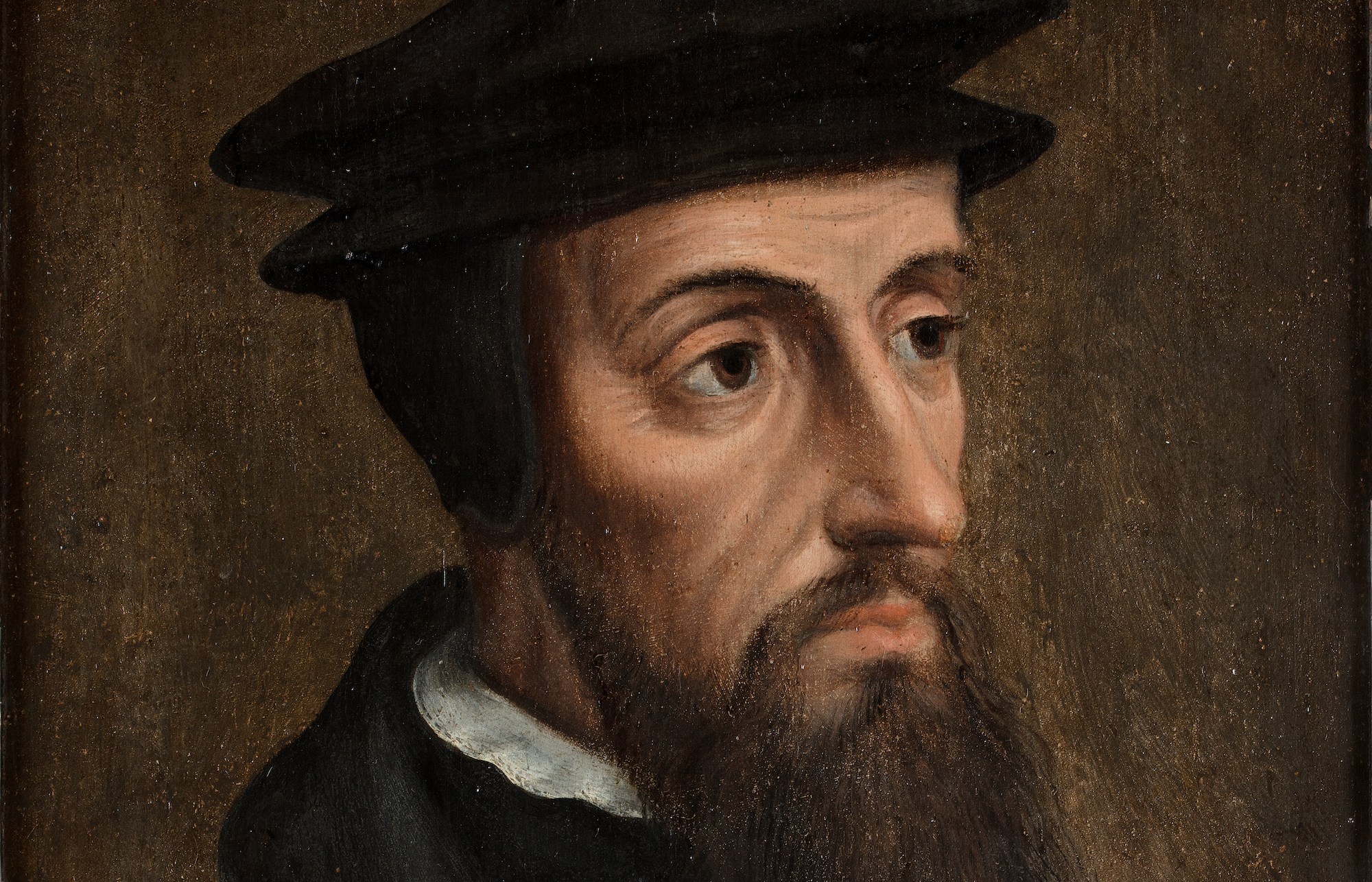
John Calvin, the most influential theologian of the Reformed tradition, was confused about predestination. Because he thought God wills (which means wants) some people to be damned.
God has never willed the damnation of anyone. He wants all people to be saved. That’s what he tells us (1 Timothy 2:4)—and we believe him.
This is the second in a series of posts responding to Book 3, Chapter 21, of Calvin’s Institutes, which is his central explanation of his understanding of predestination.
In our first post we did three things:
- Define what “predestination” is.
- Explained who John Calvin is and his influence on Christians today.
- Showed where Calvin was confused and so disagreed with the Bible.
What the Bible says about predestination is simple, even though it is paradoxical:
- God is solely responsible for our salvation. So those who have faith can see we only trust Jesus because God chose us in him.
- We are solely responsible for our damnation. So those who refuse to believe do so not because they are not chosen by God, but purely because they resist his grace.
How are those things logically true at the same time? I have no idea. We’re not given an answer to that question in the Bible. That’s exactly the point of this second post.
Today we’ll do three things:
- Summarise what Calvin actually says in Institutes 3.21.
- See what Calvin himself describes as the method for reading the Bible—and why we agree with him: what he says on this is excellent.
- Show how Calvin himself does not follow his own method in this chapter on predestination, and how that leads to his confusion about predestination.
Future posts after this one will look at the specific parts of the Bible that Calvin mentions in this chapter, and examine carefully what they actually say.
1) A Summary of Calvin’s Institutes 3.21
Here is a summary outline of the points Calvin makes in order:
Paragraph 1:
We see that not everyone has equal access to hear the Gospel, nor do they respond equally. This is because of predestination. This raises difficult questions for people. But we must teach predestination:
- to appreciate God’s free grace (Romans 11:6);
- to make us humble and bound to God; and
- to have a sure ground of confidence (John 10:26).
To not know you are elect is to live in constant fear and is pastorally unhelpful. This is the foundation of the church. Predestination is already difficult, but human speculation makes it worse. So avoid the errors two types of people make:
End of Paragraph 1 and Paragraph 2:
We should not speculate beyond God’s Word. Be happy to be ignorant of anything not revealed in it (John 16:12; Proverbs 25:27).
Paragraph 3:
We should not be scared to teach God’s Word. Teach everything God’s Word says about predestination, without going beyond it (Proverbs 25:2; Deuteronomy 29:29).
Paragraph 4:
People who criticise predestination are going to criticise whatever the church teaches. The arguments of criticisers will be dealt with in chapter 23.
Paragraph 5:
A particular criticism is made by those who say God predestines based on his foreknowledge of people’s actions. God’s foreknowledge and predestination are both true, but God doesn’t predestine based on his foreknowledge.
God’s foreknowledge is that he sees every moment in time simultaneously.
God’s predestination is “the eternal decree of God, by which he determined with himself whatever he wished to happen with regard to every man. All are not created on equal terms, but some are preordained to eternal life, others to eternal damnation; and, accordingly, as each has been created for one or other of these ends, we say that he has been predestinated to life or to death.”
Predestination applies to individuals, but is also illustrated in Abraham’s children (Deuteronomy 32:8, 9). Several verses show that the basis of positive election to life is purely because of God’s love (Deuteronomy 4:37; 7:7-8; 10:14-15; 23:5; Psalm 47:4), not because of their merit (Deuteronomy 9:6). These verses show that God’s election is not on the basis of foreknowledge.
The Israelites are pointed to free grace to give them hope (Psalms 100:3 and 95:7). They should rest in this (Psalm 105:6). God acts kindly because of his covenant (Psalm 44:3). Israel’s possession of Canaan is a symbol of their election (Psalm 33:12). Samuel’s preaching of hope is grounded in this free grace (1 Sam 12:22). David is encouraged in suffering because of this free grace (Psalm 65:4). The “two steps” of election is reflected in Isaiah’s language (Isaiah 14:1). Predestination is because of God’s Fatherly kindness (Isaiah 41:9), and Jerusalem’s suffering does not mean she is not chosen (Zech 1:17; 2:12).
Paragraph 6:
Predestination is also displayed within Abraham’s family: Ishmael, then Esau, then “an innumerable multitude, almost the whole of Israel” were “cut off.” Saul was “a similar example,” and Calvin describes this as “celebrated” by Psalm 78:67-68.
As we noted in part 1, Calvin makes a crucial observation about all these passages: “I admit that it was by their own fault Ishmael, Esau, and others, fell from their adoption.”
But even these who fell away had experienced some form of election (Psalm 147:20). He explains that God’s kindness to the elect is seen in his reprobation of others: “he was by no means to be restricted to an equal division of grace, its very inequality proving it to be gratuitous.” (Malachi 1:2-3)
Paragraph 7:
The final paragraph is about the double predestination of individuals. God “so assigns” election “that the certainty of the result remains not dubious or suspended.”
Those in Abraham are elect, but this includes some who do not have eternal life. Within this are a group who are elect in Christ. These are the “one seed” (Romans 9:8; Galatians 3:16), and this is what Paul is explaining in Romans 9:13 from Malachi 1:2.
While “Jacob I have loved” refers to the one man Jacob, within his progeny is another elect, called “the remnant” (Romans 9:27; 11:5). We know this “because experience shows that of the general body many fall away and are lost, so that often a small portion only remains.”
The reason why the general election (of Abraham, Jacob, etc.) results some people being damned is because God “does not immediately bestow the Spirit of regeneration.” Everything therefore rests on God’s counsel alone: “as regards the elect, is founded on his free mercy, without any respect to human worth, while those whom he dooms to destruction are excluded from access to life by a just and blameless, but at the same time incomprehensible judgment.”
2) Calvin is Right About How to Read the Bible
Everything Calvin says in this chapter about how to read the Bible and listen to what it says about predestination is absolutely correct.
He rightly says we should not go beyond the Word (emphasis in all places is mine):
the word of the Lord is the only way which can conduct us to the investigation of whatever it is lawful for us to hold with regard to him—is the only light which can enable us to discern what we ought to see with regard to him, it will curb and restrain all presumption. For it will show us that the moment we go beyond the bounds of the word we are out of the course, in darkness, and must every now and then stumble, go astray, and fall. Let it, therefore, be our first principle that to desire any other knowledge of predestination than that which is expounded by the word of God, is no less infatuated than to walk where there is no path, or to seek light in darkness. Let us not be ashamed to be ignorant in a matter in which ignorance is learning. Rather let us willingly abstain from the search after knowledge, to which it is both foolish as well as perilous, and even fatal to aspire. (Calvin’s Institutes 3.21.2)
And he rightly says we should listen to what the Word says and teach it fully—as long as we don’t go beyond it:
Let us, I say, allow the Christian to unlock his mind and ears to all the words of God which are addressed to him, provided he do it with this moderation—viz. that whenever the Lord shuts his sacred mouth, he also desists from inquiry. (Calvin’s Institutes 3.21.3)
Only I wish it to be received as a general rule, that the secret things of God are not to be scrutinized, and that those which he has revealed are not to be overlooked, lest we may, on the one hand, be chargeable with curiosity, and, on the other, with ingratitude. (Calvin’s Institutes 3.21.4)
He also rightly cites Deuteronomy 29:29 as a key verse that teaches us how to read the Bible:
The secret things belong to the LORD our God, but the things that are revealed belong to us and to our children forever, that we may do all the words of this law.
And Calvin is completely right to conclude from this verse:
…it is not lawful for men to pry into the secret things of God. (Calvin’s Institutes 3.21.3)
Everything Calvin says in this chapter about how to read the Bible is completely correct. He builds a strong, biblical, argument that we should not use human reason to go beyond what Scripture actually says, no matter how curious we may be. But note that what he says about method in this chapter is stricter than what the later Reformed tradition that continued from Calvin taught. For example, the Westminster Confession of Faith 1.6 goes further when it says:
The whole counsel of God… is either expressly set down in Scripture, or by good and necessary consequence may be deduced from Scripture
But this later Reformed tradition did not change how Calvin actually read the Bible. It merely put into words what Calvin himself was already doing. Calvin was absolutely correct to say:
- we should only teach what the Bible says;
- we should not speculate beyond what the Bible says; and
- we should fully teach everything that the Bible says.
The problem is he and the tradition that later came from him do not read the Bible consistently in this way.
3) Calvin is Inconsistent in How He Actually Reads the Bible
Calvin opens the chapter by drawing a conclusion from an observation of the world:
The covenant of life is not preached equally to all, and among those to whom it is preached, does not always meet with the same reception. This diversity displays the unsearchable depth of the divine judgment, and is without doubt subordinate to God’s purpose of eternal election. But if it is plainly owing to the mere pleasure of God that salvation is spontaneously offered to some, while others have no access to it… (Calvin’s Institutes 3.21.1)
Because “eternal election” for Calvin means both election to life and reprobation to death, Calvin is making two assumptions here from his observation of the world that go beyond what the Bible says:
The first assumption is that God’s secret election can be discerned from looking at the scope of how far the Gospel has been preached. The Bible does say that Israel were privileged to have the scriptures (Romans 3:2). But God explicitly says to Paul in Acts 18:9-10 that the doctrine of election means he should keep preaching the Gospel to those who have not heard it in Corinth. The fact that the Gospel had not been preached equally to all in Corinth did not “display… the unsearchable depth of the divine judgment.” That many had not already heard the Gospel in Corinth did not reveal that God had not chosen people there.
The second assumption is that the reception of the Gospel reveals that God has chosen for some to not be saved. The Bible does say that when people respond positively to the Gospel, this reveals that God has chosen them and given them faith (1 Thessalonians 1:4-5). But when people respond negatively to the Gospel, the Bible always says this is because of their unbelief, not because God has not chosen them (Romans 11:20).
Having opened the chapter by claiming from his observation of the world that predestination means both election to life, and reprobation to damnation, for the rest of the chapter Calvin speaks as though every passage that teaches election to life necessarily teaches reprobation.
By doing this Calvin has—unintentionally—broken his own principle that “the moment we go beyond the bounds of the word we are out of the course” (paragraph 2).
As noted in the first post in this series, Calvin therefore uses language that doesn’t just go beyond what the Bible says, but actually contradicts it.
Calvin says “All are not created on equal terms” (paragraph 5) by which he means that some are created for eternal life and others for eternal damnation. But in Acts 17:26-27 Paul tells the Areopagus:
And he made from one man every nation of mankind to live on all the face of the earth, having determined allotted periods and the boundaries of their dwelling place, that they should seek God, and perhaps feel their way toward him and find him.
Calvin says “it was his pleasure to doom [some] to destruction” (paragraph 7). But the Bible never speaks of God’s pleasure in this way, but in fact always says the opposite. As Paul writes in 1 Timothy 2:3-4:
This is good, and it is pleasing in the sight of God our Savior, who desires all people to be saved and to come to the knowledge of the truth.
Calvin says some “are excluded from access to life by a just and blameless, but at the same time incomprehensible judgment.” (paragraph 7). But the Bible never says people are excluded from access to life because of anything in God, but only because of their own unbelief. In contrast, Jesus explicitly reveals in John 6:40 that God’s will excludes no believer from eternal life:
For this is the will of my Father, that everyone who looks on the Son and believes in him should have eternal life, and I will raise him up on the last day.
But Calvin does not just go beyond what the Bible says and contradict what the Bible says, he also doesn’t follow through on the principle that “those which he has revealed are not to be overlooked” (paragraph 4). Because, as we have noted several times, Calvin recognises in paragraph 6: “I admit that it was by their own fault Ishmael, Esau, and others, fell from their adoption.” But he does not explore what this means, or how the Bible itself unpacks this important observation.
That is Calvin’s confusion in Institutes 3.21.
He rightly says we must not go beyond what God has revealed.
He rightly says we must teach everything God has revealed.
He rightly says election is not based on foreseen merit.
He rightly says Christians should find comfort in God’s gracious choice in Christ.
But then he goes further. And he doesn’t teach everything the Bible does say.
He claims God has chosen and created some people for eternal damnation.
He does not speak here about what the Bible reveals about human responsibility for unbelief.
The Bible says believers are saved because God chose them in Christ. The Bible says unbelievers are lost because they resist, reject, and refuse the grace of God. The Bible reveals the first as God’s gracious election. And it reveals the second as man’s unbelieving fault.
Where Scripture gives us both truths, we confess both.
Where Scripture does not explain how they fit together, we stop.
In this chapter Calvin was completely right about how to read the Bible. He just does not do what he so helpfully describes.
In the next posts, we will look at the specific passages Calvin uses, and see whether they actually teach what Calvin says they teach.