
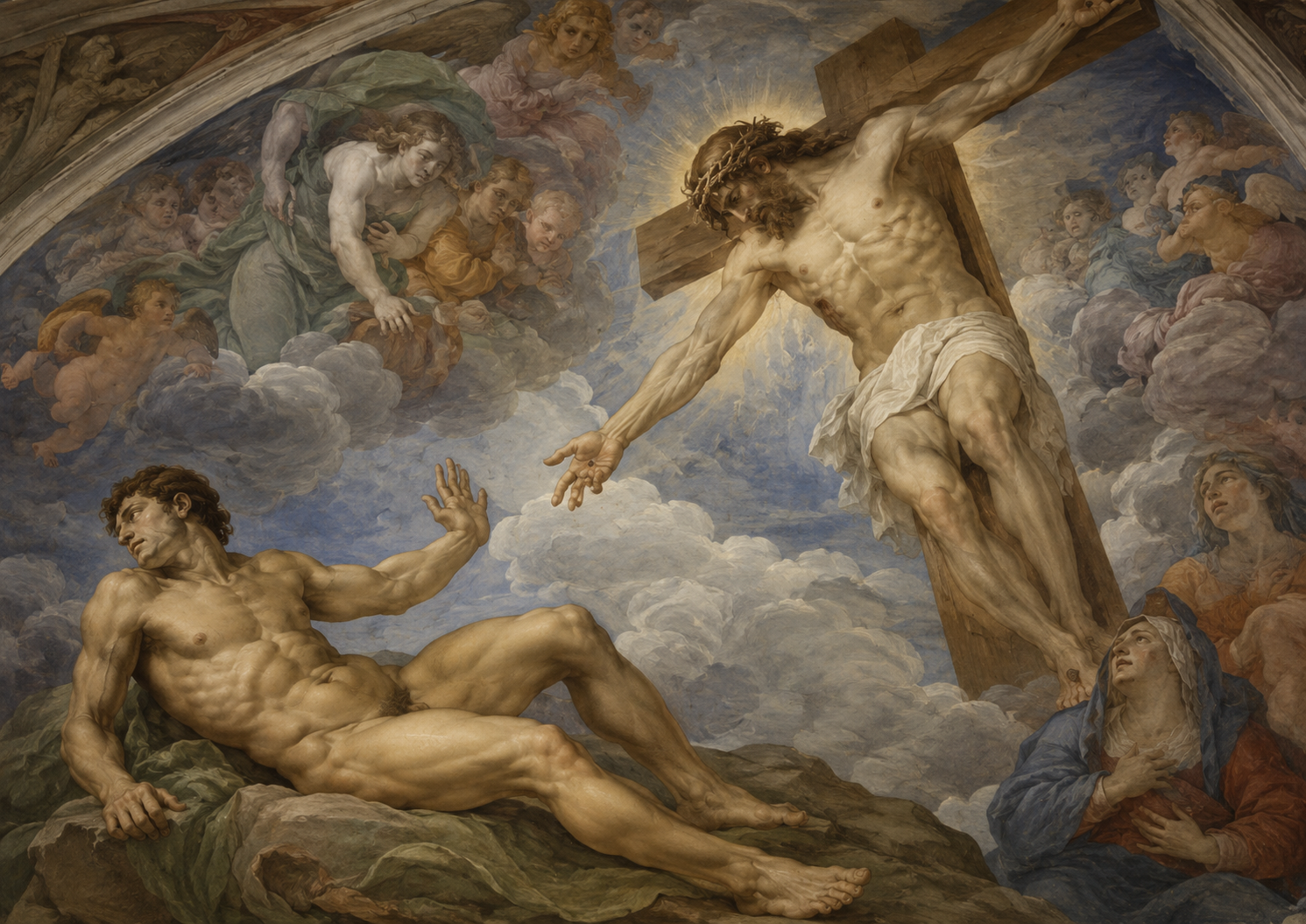
I was recently asked a series of excellent questions about universalism.
The questions arise from a real tension. The Bible teaches that Jesus died for the sins of the whole world. God genuinely reconciled the world to himself through the blood of Christ. He sincerely desires the salvation of every person.
Does that mean that everyone will finally be saved?
It may seem like the natural conclusion. But Christian theology is not built by taking one biblical truth and following its apparent implications as far as our reason will carry us. We must listen to everything God has said—including Christ’s own solemn warnings about hell.
With the writer’s permission, I have lightly edited and anonymised our exchange. His questions deserve serious answers, because they press us to proclaim the Gospel as fully and objectively as Scripture does, without weakening a single word of Christ’s warnings.
The writers words are in the headings:
I just read your ”Luther Preached the Gospel So Objectively that It Sounded Universalist” on your blog. And it was very interesting to read, to see what Luther said that sounded universalist. I have made a journey in my life. I lost my childhood faith in my teenage years. Then I had a lot of different faiths. Then I came back to the Bible, to lutheranism even. But with a twist. I was now a Universalist. I wanted to send you my response to what you wrote. I have used AI to aid me a bit so you know: I appreciate the emphasis on Christ’s objective work and on directing people away from themselves and toward Jesus. That is a profoundly biblical emphasis.
Glad we start from a place of agreeing on some important things. And thank you for the privilege of being asked questions.
However, I think this line of reasoning stops short of its own implications.
Theology is not what we see “implied”. We do not build theology using our reason. We simply receive what God says in simple faith. The Bible is full of paradoxes that God does not provide the answers to. Moses says:
The secret things belong to the LORD our God, but the things that are revealed belong to us and to our children forever, that we may do all the words of this law. (Deuteronomy 29:29)
I wrote a series of blog posts about predestination, which explained why we become confused if we use our reason to build theology as John Calvin did. You can read it here: https://manchesterlutheran.church/calvins-confusion-about-predestination/
If Christ truly bore the sins of the whole world and if God has genuinely reconciled the world to Himself in Christ, then why should we assume that this victory will ultimately fail for most of humanity?
We don’t assume anything, Jesus directly tells us some people will be in hell, even though God did not prepare it for them:
Then he will say to those on his left, ‘Depart from me, you cursed, into the eternal fireprepared for the devil and his angels. (Matthew 25:41)
I published a video on hell last month: https://www.youtube.com/watch?v=hrIhdJjaAao
If sin, death, and the curse have been objectively defeated in Christ, it seems natural to ask whether God intends to bring that victory to its full completion in every person.
Yes. God does intend this:
For God has consigned all to disobedience, that he may have mercy on all. (Romans 11:32)
But he also tells us it won’t happen. Not because of God’s choice, but because of their own resistance of him:
Rom. 10:1 Brothers, my heart’s desire and prayer to God for them is that they may be saved. 2 For I bear them witness that they have a zeal for God, but not according to knowledge. 3 For, being ignorant of the righteousness of God, and seeking to establish their own, they did not submit to God’s righteousness. (Romans 10:1-3)
I explain Romans 9-11 in the blog series on predestination.
Luther’s language is strikingly expansive. When he says that Christ has taken away the sins of the world, conquered death, and overcome the curse for all, those statements sound genuinely universal in scope. Rather than weakening the Gospel, they magnify the sufficiency and power of Christ’s atoning work.
They don’t just sound universal. They are universal. Christ really has redeemed the whole world.
Faith remains essential, not because it makes Christ’s work true, but because it awakens us to the reality of what Christ has already accomplished. In that sense, faith is the joyful recognition and participation in God’s saving work, not its cause.
I agree with all this, but would be cautious about the word “participation”. That needs careful qualifying. But I know you used AI for the translation. And I know no Swedish.
From a Christian universalist perspective, passages such as Romans 5:18-19, 1 Corinthians 15:22-28, and Colossians 1:19-20 suggest that the same Christ who objectively reconciled the world will ultimately bring that reconciliation to its intended fulfillment.
These passages teach universal, i.e. objective, justification. But they do not directly teach universal final salvation.
Why? Because of what “justification” means. It means:
- Our sin was fully taken away and borne by Christ. — this is true for all people, so it’s true for me.
- Christ’s righteousness was fully given to us. — this is true for all people, so it’s true for me.
- God’s wrath was fully borne by Christ, so from God’s side we are reconciled and he genuinely wants the salvation of all people.
However, the problem is not what God wants, it’s what people want. They don’t want God’s reconciliation. They don’t want Christ’s death to count for them. They want their works to count for themselves. So, they resist his Spirit and reject the Gospel.
So, straight after Romans 5:18-19, Paul explains how this objective justification is applied to us: through baptism (Romans 6). But, he warns the Romans that presenting ourselves as slaves to sin leads to death:
16 Do you not know that if you present yourselves to anyone as obedient slaves, you are slaves of the one whom you obey, either of sin, which leads to death, or of obedience, which leads to righteousness? (Romans 6:16)
Martin Chemnitz forcefully argued against the Reformed that the doctrine of “apostasy” (falling away from the faith) is real, and he did so primarily from Romans.
Romans 5:18-19 is true. Christ’s death leads to justification and life for all men. I in no way deny this. I fully affirm it. But I also fully affirm Romans 6:20-21:
Rom. 6:20 For when you were slaves of sin, you were free in regard to righteousness. 21 But what fruit were you getting at that time from the things of which you are now ashamed? For the end of those things is death. (Romans 6:20-21)
If we are truly Christian, then we must affirm everything Scripture says. Both Romans 5:18-19, and also Romans 6:20-21.
The cross is not merely sufficient to save all, it is the decisive act through which God will finally be “all in all.”
You made this specific claim from those three passages (Romans 5:18-19; 1 Corinthians 15:22-28; Colossians 1:19-20).
This is not quite supported by them. I showed above that Paul says immediately afterwards in Romans 6 that the end of sin will be death for those who submit their members to it as slaves.
1 Corinthians 15:22-28 contains three ideas:
1) Universal atonement:
22 For as in Adam all die, so also in Christ shall all be made alive. (1 Corinthians 15:22)
2) But then only limited final reception:
23 But each in his own order: Christ the firstfruits, then at his coming those who belong to Christ. (1 Corinthians 15:23)
3) But in order to achieve this, Christ must defeat his enemies. this is the idea of God being “all in all”—that there is no more rebellion left:
24 Then comes the end, when he delivers the kingdom to God the Father after destroying every rule and every authority and power. 25 For he must reign until he has put all his enemies under his feet. 26 The last enemy to be destroyed is death. 27 For “God has put all things in subjection under his feet.” But when it says, “all things are put in subjection,” it is plain that he is excepted who put all things in subjection under him. 28 When all things are subjected to him, then the Son himself will also be subjected to him who put all things in subjection under him, that God may be all in all. (1 Corinthians 15:24-28)
The focus of these verses is on the defeat of active rebellion threatening Christ’s rule. God being “all in all” here means primarily “all his enemies are no longer an active danger.” This is not necessarily “all his enemies have repented.” Paul is clearly alluding here to Psalm 110, which ends:
5 The Lord is at your right hand; he will shatter kings on the day of his wrath. 6 He will execute judgment among the nations, filling them with corpses; he will shatter chiefs over the wide earth. 7 He will drink from the brook by the way; therefore he will lift up his head. (Psalm 110:5-7)
Your and my salvation depends on the defeat of God’s enemies—sin, satan, hell, the powers, etc.—so those who choose to side with God’s enemies will experience the same final fate. Even though God doesn’t want them to.
The final quotation you gave was:
19 For in him all the fullness of God was pleased to dwell, 20 and through him to reconcile to himself all things, whether on earth or in heaven, making peace by the blood of his cross. (Colossians 1:19-20)
Again, I 100% affirm this universal reconciliation. But Paul immediately goes on to talk about the final experience of this in eternity, which he makes conditional on remaining in the faith:
23 if indeed you continue in the faith, stable and steadfast, not shifting from the hope of the gospel that you heard, (Colossians 1:23)
I have some questions: 1. If Christ has objectively justified all people, what ultimately prevents that objective reality from becoming the final reality for everyone?
This question is addressed by Paul in Romans 9-11, which you can see explained in detail in my blog series on predestination linked above.
The short answer is: their own unbelief.
The longer answer is: “unbelief” is frequently wrongly taught and thought about in churches today. “Unbelief” is not “a failure to believe”. Unbelief is contrasted in scripture with relying on my own works. Reliance on my own works is by definition a rejection of Christ’s justification for me.
That’s why in the confession of my church we barely use the word “faith.” I have been criticised for this. But the criticisms are by people who are confused about what faith is. “Faith” has become theological language that people use without realising they mean very different things by it. Faith is simply trust in Christ rather than trust in myself.
Hebrews 4-5 clearly tells us that as long as it is called “today” I need to trust Christ rather than myself. But one day in particular will be decisive for all eternity to come: the last day, when Christ judges the world. On that day, if people are saved it is purely because of God’s grace. But, if people are lost it is because of their own choice to trust themselves rather than Christ, so he will judge them accordingly as they want:
Rev. 20:11 Then I saw a great white throne and him who was seated on it. From his presence earth and sky fled away, and no place was found for them. 12 And I saw the dead, great and small, standing before the throne, and books were opened. Then another book was opened, which is the book of life. And the dead were judged by what was written in the books, according to what they had done. 13 And the sea gave up the dead who were in it, Death and Hades gave up the dead who were in them, and they were judged, each one of them, according to what they had done. 14 Then Death and Hades were thrown into the lake of fire. This is the second death, the lake of fire. 15 And if anyone’s name was not found written in the book of life, he was thrown into the lake of fire. (Revelation 20:11-15)
No human being will be in hell because God wants them to be there. Even the people in hell are people Jesus died for and forgave: their sins genuinely were borne by Christ, and God genuinely reconciled them to him. They refused that reconciliation. They are only there because of their own will, not God’s will. I wrote a blog post on exactly this: https://manchesterlutheran.church/2026/04/11/forgiven-yet-still-in-hell/
If that is intellectually frustrating for you, then imagine how emotionally and personally devastating and upsetting it is for Jesus. In fact, he tells us exactly this:
O Jerusalem, Jerusalem, the city that kills the prophets and stones those who are sent to it! How often would I have gathered your children together as a hen gathers her brood under her wings, and you were not willing! (Luke 13:34)
Notice: Jesus is really sad about this. But also he says the reason is “you were not willing!”
2. If faith is purely passive and only recognizes what is already true, how can unbelief overturn or permanently frustrate what Christ has already accomplished?
First: unbelief cannot “permanently” frustrate what Christ has already accomplished. Paul says of people who have fallen away:
23 And even they, if they do not continue in their unbelief, will be grafted in, for God has the power to graft them in again. (Romans 11:23)
God has power to restore people who trust in Christ, even if they had returned to unbelief. Indeed, this is God’s desire.
Secondly: there are things God has not told me. All I know is this: When I look at Christ I can see that I am saved purely because I’m elect in Christ and my salvation is all of him. And yet when I look at Christ I see people reviling and rejecting him, and declaring that they are righteous in themselves and demanding God answer to them. And I see in Jesus’ suffering the consequence and final end of sin.
I see both of those realities when I look at the cross. But God does not tell me how these things fit together. My question to you is: Do you trust what God says, even when he doesn’t explain these answers?
That’s why I rigorously defend statements like:
- “God is in a good mood with you! You see that when you look at Jesus.”
- “Jesus bore the wrath of God fully for all people. There’s no wrath left.”
- “Because of Jesus, God is not angry with anyone.”
I didn’t “work these out.” These are just statements about what the Bible says, because I’m looking at Jesus on the cross.
But if you say “Everyone will be in heaven forever” then you’re not looking at Jesus on the cross. Even hanging on the cross, there were men to his right and left. One rejected and reviled him. But to the other he said “Today you will be with me in Paradise.”
Don’t look to your own understanding. Look at this.
3. You argue that we should preach the Gospel so strongly that it sounds universalist. What biblical reason is there for stopping just short of the conclusion that Christ’s victory will ultimately encompass all?
Because Christ explicitly tells us:
46 And these will go away into eternal punishment, but the righteous into eternal life. (Matthew 25:46)
I do not preach the Gospel so strongly that it sounds universalist because that makes sense to me. I preach it this way because Christ commands me that I must make disciples by baptising and “teaching them to observe all that I have commanded you.” (Matthew 28:20).
That’s why I will not in any way weaken the universal and objective Gospel promise. But it is also why I will not in any way weaken the Law’s warning that sin leads to eternal condemnation.
4. If Jesus truly took away the sin of the whole world, in what sense can the sins of the lost still remain on them forever?
Because of their own will, which is to insist on remaining outside of Christ. “I want to be judged by my own works!” Jesus explains this in John 15:
5 I am the vine; you are the branches. Whoever abides in me and I in him, he it is that bears much fruit, for apart from me you can do nothing. 6 If anyone does not abide in me he is thrown away like a branch and withers; and the branches are gathered, thrown into the fire, and burned. (John 15:5-6)
5. How do you reconcile the claim that God ‘does not want to see anything else in the whole world except cleansing and righteousness’ with the belief that most will remain eternally condemned?
God wants all to be saved. But God does not get everything he wants. I explained that in Part 6 of my series on predestination: https://manchesterlutheran.church/2026/05/23/calvins-confusion-about-predestination-6-the-potter/
6. If Christ has conquered death and the curse for the whole world, is eternal separation from God not a continuing victory for death and the curse over those people?
Scripture never says that it is. In fact, the opposite. Psalm 2 and Psalm 110 tell us Christ is victorious as he judges his enemies.
7. Would you say that Christ’s reconciliation of the world is complete but never realized for many people, or do you believe God will ultimately bring His reconciling work to its intended completion?
Paul describes how God has reconciled the world to himself. But people refuse to be reconciled to God. Gospel ministry is declaring the universal reconciliation, and imploring people to look at Christ and be reconciled.
18 All this is from God, who through Christ reconciled us to himself and gave us the ministry of reconciliation; 19 that is, in Christ God was reconciling the world to himself, not counting their trespasses against them, and entrusting to us the message of reconciliation. 20 Therefore, we are ambassadors for Christ, God making his appeal through us. We implore you on behalf of Christ, be reconciled to God. (2 Corinthians 5:18-20)
8. If God sincerely wills the salvation of all and Christ has objectively accomplished everything necessary for all, what is the theological basis for believing that God’s saving purpose will finally fail for some, or yes, in fact even most of us?
The same theological basis as for every doctrine: God tells us clearly in his Word.
That is not merely an answer to a theological puzzle. It is the reason the Church continues to preach the Gospel.
God has reconciled the world to himself in Christ. Jesus has borne your sins. He does not ask you to establish your own righteousness, solve every paradox or make yourself worthy of his mercy. He calls you to stop looking at yourself and to look at him.
The question is not whether Christ has done enough for you. He has.
The question is whether you will benefit from that promise.
Come and hear that promise for yourself.
If you live near Greater Manchester, come and receive the forgiveness Jesus gives at Manchester Lutheran Church every Sunday. Join us at 10:45am for coffee and 11:00am for the service: https://mcrlt.ch/sundays/
If you live outside Greater Manchester, you can hear and receive Jesus’ forgiveness online with the Confessional Lutheran Church every Wednesday at 6:00pm: https://lutheran.ch/online-service/
Leave a Reply