
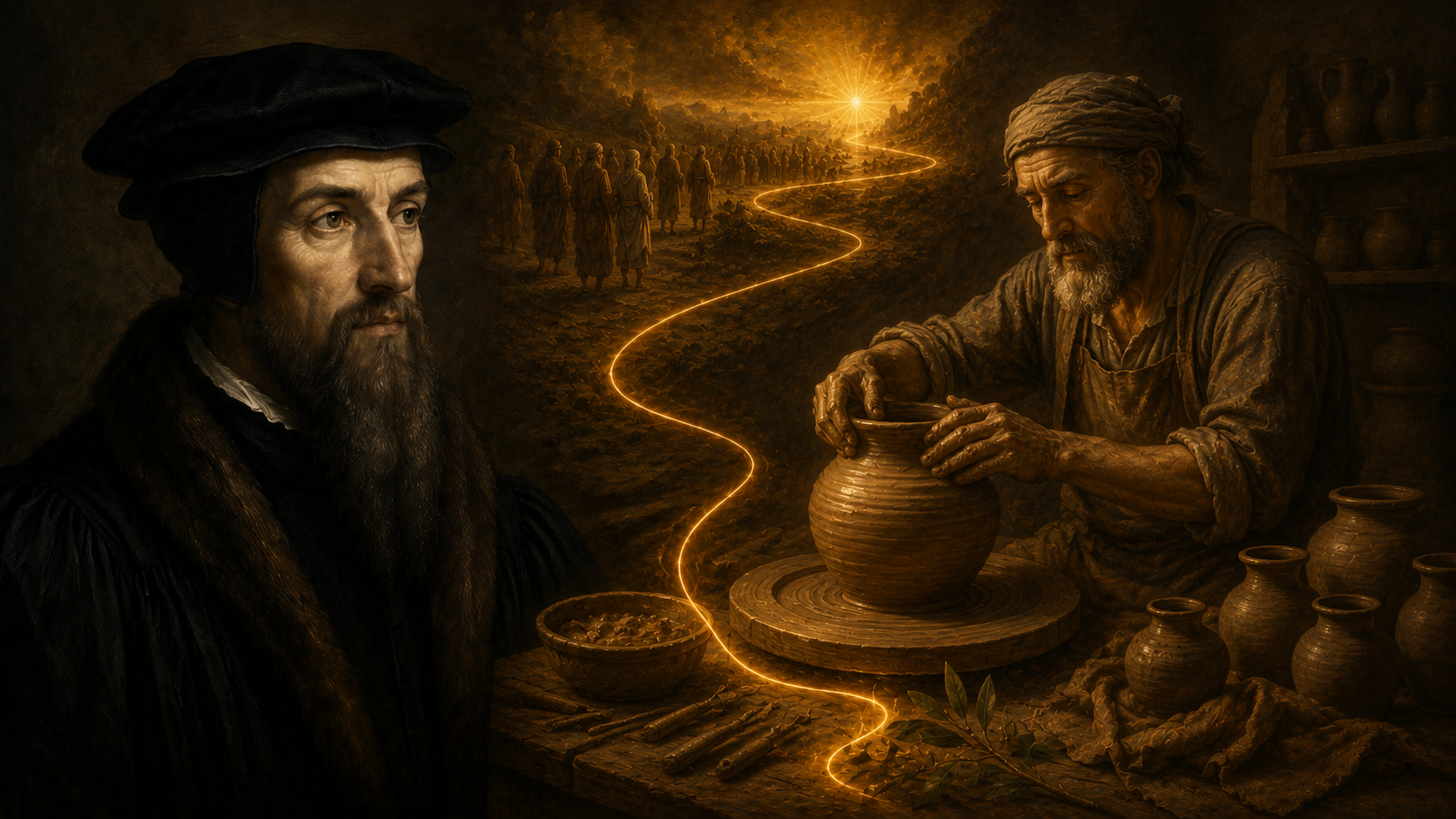
God is all powerful. But that does not mean he is pleased with all things that happen, nor that he gets all that he desires.
That is a logical leap made by the influential Reformed theologian John Calvin that led to him being confused about what the Bible says about God’s power. Calvin claimed that everything that happens is God’s will, and therefore the fact that people perish shows us God’s will was that they would perish.
This directly contradicts the Bible, which simply presents us with a paradox that it never resolves:
God is all powerful, Jesus explicitly says
with God all things are possible (Matthew 19:26).
But that does not mean he is pleased with all things that happen, God explicitly says
I have no pleasure in the death of the wicked (Ezekiel 33:11)
And yet God himself says that this very thing God does not take pleasure in happens:
The soul who sins shall die. (Ezekiel 18:20).
Nor that he gets all that he desires, the apostle Paul explicitly tells us in one place that God
desires all people to be saved and to come to the knowledge of the truth. (1 Timothy 2:4).
And yet in another he tells us
The coming of the lawless one is by the activity of Satan with all power and false signs and wonders, and with all wicked deception for those who are perishing, because they refused to love the truth and so be saved. (2 Thessalonians 2:9-10)
I do not know how these things fit together logically because God does not tell me.
This is part six of a series of posts addressing John Calvin’s confusion about the doctrine of election. Posts one and two described this confusion. Post three explained the apostle Paul’s discussion of predestination in Romans 9-11. Post four zoomed in on Genesis, Malachi and Romans 9:6-13. And post five explained mercy and hardening in Exodus and Romans 9:14-18.
In this post we will look at Paul’s illustration of God as the great potter working with human clay in Romans 9:19-23.
1) The Context
Paul has just said that God
has mercy on whomever he wills, and he hardens whomever he wills. (Romans 9:18)
Which raises a natural objection:
You will say to me then, “Why does he still find fault? For who can resist his will?” (Romans 9:19)
Paul’s reply is to say that God is judge of the world and we are not, so we are not in a position to question things God has not revealed. He does this by drawing on an image from the Old Testament of God as a potter:
But who are you, O man, to answer back to God? Will what is moulded say to its moulder, “Why have you made me like this?” Has the potter no right over the clay, to make out of the same lump one vessel for honourable use and another for dishonourable use? (Romans 9:20-21)
Here’s where the confusion is slipped in by those who read the Bible through the lens of their own reason, even if—as Calvin explicitly says—they don’t intend to. Because this image of God as a potter does not say that all things that happen are things God wills to happen.
This is important, and it’s subtle, so let’s slow down a moment to understand it.
The Bible absolutely says that God:
works all things according to the counsel of his will, (Ephesians 1:11)
And:
does all that he pleases. (Psalm 115:3)
And God even says through Isaiah:
I am God, and there is none like me, declaring the end from the beginning and from ancient times things not yet done, saying, ‘My counsel shall stand, and I will accomplish all my purpose,’ (Isaiah 46:9-10)
But! None of those statements explicitly say:
“All things that happen are God’s will.”
That claim is a logical inference. A logical inference that John Calvin and many who follow him make. But not a logical inference that the Bible makes.
Let’s zoom in on this picture of the potter working with clay, and see what it does teach. Paul is drawing on the prophet Jeremiah who first used this picture, so we’ll start there.
2) The Potter in Jeremiah 18
Here is a prophetic story the prophet Jeremiah tells:
1 The word that came to Jeremiah from the LORD: 2 “Arise, and go down to the potter’s house, and there I will let you hear my words.” 3 So I went down to the potter’s house, and there he was working at his wheel. 4 And the vessel he was making of clay was spoiled in the potter’s hand, and he reworked it into another vessel, as it seemed good to the potter to do.
5 Then the word of the LORD came to me: 6 “O house of Israel, can I not do with you as this potter has done? declares the LORD. Behold, like the clay in the potter’s hand, so are you in my hand, O house of Israel. 7 If at any time I declare concerning a nation or a kingdom, that I will pluck up and break down and destroy it, 8 and if that nation, concerning which I have spoken, turns from its evil, I will relent of the disaster that I intended to do to it. 9 And if at any time I declare concerning a nation or a kingdom that I will build and plant it, 10 and if it does evil in my sight, not listening to my voice, then I will relent of the good that I had intended to do to it. 11 Now, therefore, say to the men of Judah and the inhabitants of Jerusalem: ‘Thus says the LORD, Behold, I am shaping disaster against you and devising a plan against you. Return, every one from his evil way, and amend your ways and your deeds.’
There are three important things to note about this story:
First, God’s explanation tells Judah that as the clay they spoiled themselves. The potter is working with clay, but that clay is spoiled. The spoiling of the clay is not presented as the potter’s intention, desire, pleasure, or “will”. The potter did not want the clay to be spoiled. In the explanation that follows the Lord attributes the nation’s problems to their own doing of evil, not to a decision by God prior to this.
Second, the potter does whatever he wills in response to the clay. In v. 4 the potter acts in response to the spoiled clay “as it seemed good to the potter to do.” You could say the potter works the clay “according to the counsel of his will.” (cf. Ephesians 1:11).
Third, the potter favours forgiveness and mercy. In the explanation of the picture in vv. 5-11, God explains to Jeremiah that if a nation hardens themselves, then God will act through his Law to bring curse. But if the nation turns from its evil, then the potter will relent and not bring disaster. The potter holds no grudge, harbours no ill-will. And even though the potter must declare he is shaping disaster against the evil of Judah and Jerusalem, he ends by appealing to them to repent.
This is the picture of the potter in Jeremiah. All powerful. But not deterministic. This is a picture of an almighty God who is not Manichaean (to use a really old word).
Now let’s see what Paul does with this image from Jeremiah.
3) The Potter in Romans 9
First, note what Paul says the potter is doing in vv. 20-21:
Will what is moulded say to its moulder, “Why have you made me like this?” Has the potter no right over the clay, to make out of the same lump one vessel for honourable use and another for dishonourable use? (Romans 9:20-21)
The potter is moulding (i.e. fashioning) the clay. He makes things out of the same lump. This is not a picture of a predetermined decision. The clay is already the type of clay it is. The potter does not determine the type of clay it is—only the type of vessel he will fashion from it.
The next two verses are misunderstood by so many people, simply because they are not read carefully enough:
What if God, desiring to show his wrath and to make known his power, has endured with much patience vessels of wrath prepared for destruction, in order to make known the riches of his glory for vessels of mercy, which he has prepared beforehand for glory (Romans 9:22-23)
The misunderstanding so often placed on these verses is as though Paul were saying something different—something symmetrical:
“vessels of wrath he has prepared beforehand for destruction”
“vessels of mercy he has prepared beforehand for glory”
But what Paul says is NOT symmetrical in this way.
First, remember the context. Back in v. 17, Paul quoted God telling Pharaoh that in response to Pharaoh’s stubbornness God could have simply destroyed him immediately. But God hadn’t. He had been patient with Pharaoh and not destroyed him. In fact, God “raised him up”—so that God’s power could be seen in his response to Pharaoh’s resistance. (Check out our previous post for a full explanation.)
Similarly, here, God is patient with the vessels of wrath, so that his power can be displayed—just as he was with Pharaoh. This is the use God is fashioning out of their stubbornness, but as the potter he is not the one who made the clay to be stubborn.
Second, pay careful attention to the language. It is asymmetrical. When talking about the “vessels of wrath” Paul’s picture is more similar to the potter in Jeremiah 18: he is responding to the clay. When talking about the “vessels of mercy” Paul uses language not present in Jeremiah 18: the potter has prepared them before they ever hit the potter’s wheel.
The English ESV translation I am using this post does a good job of bringing this out, but to really drive it home, here’s the original Greek:
| v. 22: | σκεύη | ὀργῆς | κατηρτισμένα | εἰς | ἀπώλειαν | |
| vessels | of wrath | that shaped themselves / that have been fitted | for | destruction | ||
| v. 23: | σκεύη | ἐλέους | ἃ | προητοίμασεν | εἰς | δόξαν; |
| vessels | of mercy | which | he prepared beforehand | for | glory |
Paul does not use the same verb in v. 22 and v. 23.
The verb in v. 22 is often used for something like “fashioned”, or “shaped” or “repaired”. It’s used in Matthew 4:21 to refer to the disciples “mending” their fishing nets. This fits the potter image of Jeremiah 18 quite well: responding to the spoilt clay by fashioning it into something useful.
The verb in v. 23 is more directly “prepared” and it has an attached preposition to indicate past time. “Prepared beforehand” is a great rendering.
The verbs also differ in their voice.
The verb in v. 22 is in what’s called the middle/passive form. Read with middle force, it could suggest that the vessels have become fitted for destruction in connection with their own stubbornness, like Pharaoh. Read passively, it means they have been fitted for destruction. Either way, Paul does not say what he says in v. 23. In v. 23 the verb is active: God himself prepared the vessels of mercy beforehand for glory. The asymmetry matters. One group of vessels is prepared by God beforehand. The other is not.
The important point here is this: Calvin reads these verses as though the verb in v. 23 were also used in v. 22. That is not the case. Paul does not say that God prepared vessels of wrath beforehand.
Calvin’s reading fails to make sense of how Paul’s argument then develops. Because he immediately goes on to show that even when Israel were effectively Gentiles, God in his mercy chose to make them his people again (vv. 25-26 by quoting Hosea). He then expresses a similar idea through the theme of the remnant (vv. 27-29 by quoting Isaiah). And then he explains in Romans 9:30-10:4 why many in Israel have not obtained salvation—not because they are not chosen, but because “they did not pursue it by faith, but as if it were based on works” (9:32).
The takeaway from all this is: don’t resist God through unbelief by continuing to rely on your works. God is all powerful. But you have real agency. If you resist him, you are responsible, and you will perish.
He does not want this.
That is why he has given you the church. Because it is in the church where you receive God’s Word, through which he gives you faith. Faith that you cannot create on your own. Faith that receives God’s mercy and grace.
So, come and let’s receive through God’s Word together:
Leave a Reply