

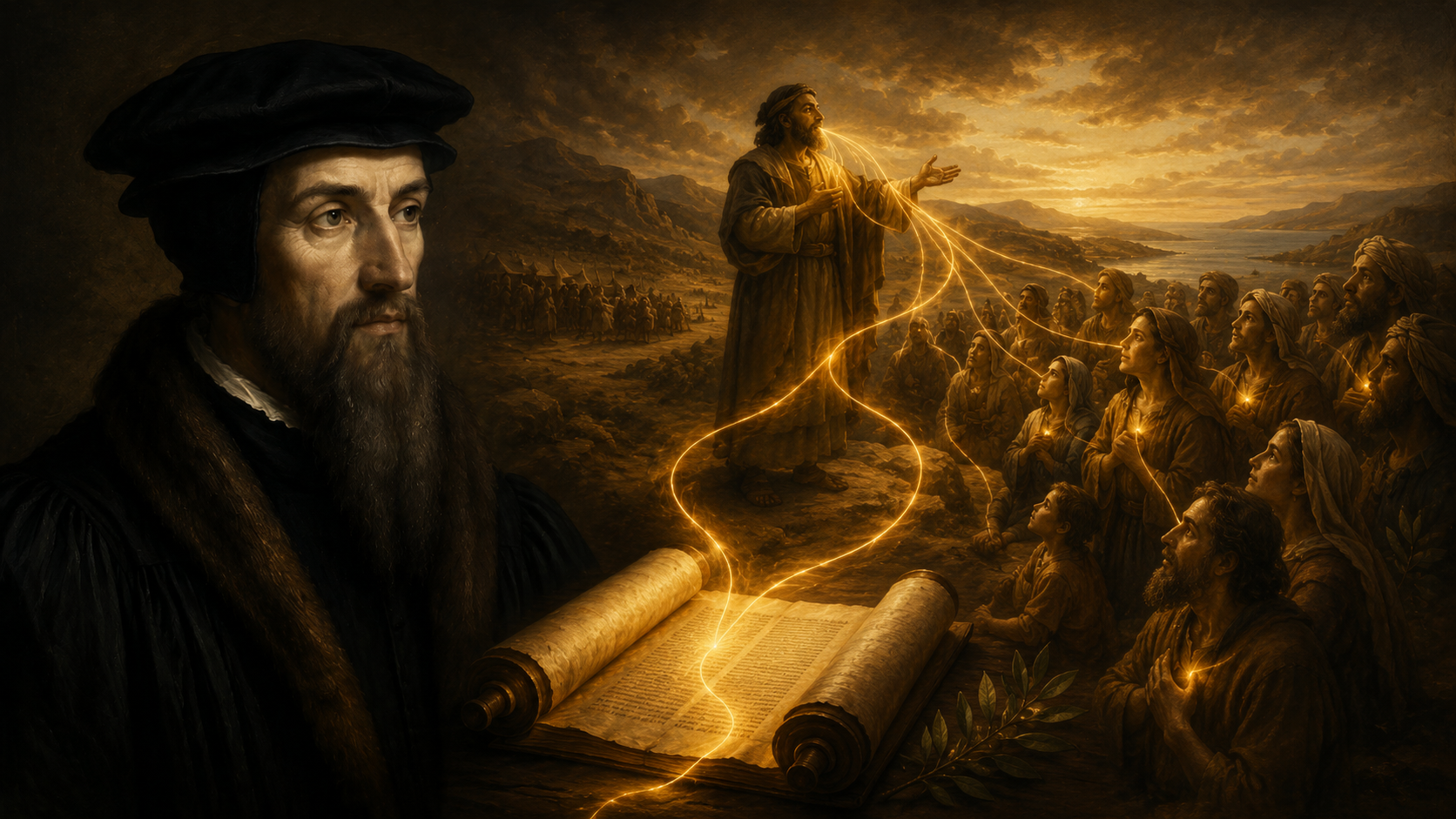
How do I know God has chosen me? In the apostle Paul’s clearest discussion of predestination, the middle chapter is all about preaching the Gospel. But in John Calvin’s key chapter on predestination, he barely mentions proclamation at all.
This contrast is crucial for understanding Calvin’s confusion about predestination.
This is part seven of a series of posts addressing John Calvin’s confusion about the doctrine of election. Posts one and two described this confusion. Post three explained Romans 9-11, one of the Bible’s clearest discussions on predestination. Posts four, five, and six have stepped through the Old Testament background to Romans 9 in more detail, showing where Calvin went beyond what the Bible says.
This post is about what Calvin simply doesn’t talk about in Institutes 3.21—and why this omission is so important.
In summary: We cannot and do not know God beyond what he says. We cannot fathom God, or his mind, behind or beyond his Word. But that is exactly what Calvin tries to do in Institutes 3.21. He tries to understand and discuss God’s bare decree about individuals before the beginning of time. But the Bible never allows us to do this.
We only know God as he reveals himself in Jesus. And what he says to us in the Gospel is: Christ has died for you, your sins are forgiven, you are mine. That’s how I know God has chosen me, because Christ died for me.
This point was so important to the apostle Paul, that in three chapters on predestination, the entire middle chapter is given over purely to discuss the Gospel, how it comes to people, its effects on them, and their responses to it.
1) The point of Romans 10
The problem that Paul is addressing in this chapter is: “Why don’t Israel have God’s righteousness?” But he answers it almost immediately by saying “Because they don’t have faith.” The rest of the chapter is focused on that.
And in order to answer why Israel don’t have faith, Paul must explain how people come to faith.
Paul sets up the problem in this way:
10 Brothers, my heart’s desire and prayer to God for them is that they may be saved. 2 For I bear them witness that they have a zeal for God, but not according to knowledge. 3 For, being ignorant of the righteousness of God, and seeking to establish their own, they did not submit to God’s righteousness. 4 For Christ is the end of the law for righteousness to everyone who believes. (Romans 10:1-4)
The reason the Jews have not obtained God’s righteousness is because they tried to establish their own righteousness—i.e. through works, through the Law—rather than submitting to God’s righteousness—i.e. through faith, through the Gospel.
In contrast, Calvin ascribes the reason why many do not obtain righteousness to an incomprehensible decision that God has made about them:
those whom he dooms to destruction are excluded from access to life by a just and blameless, but at the same time incomprehensible judgment. (Calvin’s Institutes 3.21.7)
This is why Calvin does not need to devote much discussion to the proclamation of the Gospel, or even faith, in his chapter on predestination. Because the entire way he is thinking about it is simply different to Paul.
For Calvin, to answer the question “Do I have eternal life?” I must somehow look at whether I’m elect or not.
For Paul, I must look at the Gospel which says “Christ already died to give me life” and nowhere else.
Having claimed in 10:1-4 that the Jews have not obtained God’s righteousness because they did not pursue it through faith, Paul now has to explain why it is they do not have faith, while in contrast the Gentiles do. Because as Paul has already said back in Romans 9:4, to the Jews “belong the adoption, the glory, the covenants, the giving of the law, the worship, and the promises.” How could these people not have faith?
Paul’s answer is to draw out the contrast between Law and Gospel.
2) Law and Gospel in Romans 10
In Romans 10:5-8, Paul describes two types of righteousness: a righteousness based on law (v. 5), and a righteousness based on faith (vv. 6-8).
The righteousness based on law is righteousness obtained by behaving perfectly. Paul proves this by citing Leviticus 18:5:
the person who does the commandments shall live by them. (Romans 10:5)
Pursuing this kind of righteousness seeks assurance by looking at myself and my works.
However, the righteousness based on faith is righteousness given to you by God through the Word. Paul proves this by citing Deuteronomy 30:12-14:
6 But the righteousness based on faith says, “Do not say in your heart, ‘Who will ascend into heaven?’” (that is, to bring Christ down) 7 “or ‘Who will descend into the abyss?’” (that is, to bring Christ up from the dead). 8 But what does it say? “The word is near you, in your mouth and in your heart” (that is, the word of faith that we proclaim); (Romans 10:6-8)
Pursuing this kind of righteousness seeks assurance by looking at the Gospel of Jesus.
Moses and Paul’s language should be understood as a big cautionary tale for what Calvin tries to do. Calvin seeks to look beyond the Gospel at God’s eternal decree. But we should not seek to ascend above the cross to discern God’s eternal decree. Nor should we descend down into ourselves to discern evidence of God’s election in our hearts. We should just look at Jesus—he died for me. So I know I am elect.
But: Israel in Paul’s day were not doing this.
Back in Deuteronomy, Moses had just assured the people that:
And the LORD your God will circumcise your heart and the heart of your offspring, so that you will love the LORD your God with all your heart and with all your soul, that you may live. (Deuteronomy 30:6)
To have a circumcised heart means to have faith. The Israelites are not able to circumcise their own hearts—God must do it for them. The question is: how does he do this? Moses’ answer in vv. 11-14 is through the word that is now in you. And that’s why Paul cites Moses here in Romans 10.
Paul then explains the relationship between the Word, faith and Jesus:
9 because, if you confess with your mouth that Jesus is Lord and believe in your heart that God raised him from the dead, you will be saved. 10 For with the heart one believes and is justified, and with the mouth one confesses and is saved. (Romans 10:9-10)
The Word of Jesus comes to you, you believe it, and so confess that Word out loud. This—Paul is literally saying—is what Deuteronomy 30:14 truly means:
“The word is near you, in your mouth and in your heart”
Which Paul already explained as:
(that is, the word of faith that we proclaim)
The only clarification that now comes in the age of the New Testament, Paul says, is that the “word of faith” Moses was talking about is the confession that “Jesus is Lord.”
This word of faith is objective and public: “Jesus is Lord.” He has died. He has risen. He is enthroned over all creation. Paul does not direct us to a subjective and private message hidden in eternity: “You personally are elect.” He directs us to the public Gospel of Christ. There is no need to search for a secret decree about yourself behind Jesus, because God has revealed his saving heart publicly in Jesus. All have sinned (Romans 3:23). All are justified freely by God’s grace through the redemption in Christ Jesus (Romans 3:24). Those who receive this through faith benefit from it (Romans 3:25). This faith is nothing more than seeing and receiving what is already true.
Paul then proves that this is the true, Jewish, prophetic and traditional interpretation of Moses’ words by quoting Isaiah 28:16 and Joel 2:32:
11 For the Scripture says, “Everyone who believes in him will not be put to shame.” 12 For there is no distinction between Jew and Greek; for the same Lord is Lord of all, bestowing his riches on all who call on him. 13 For “everyone who calls on the name of the Lord will be saved.” (Romans 10:12-13)
So, in order to receive God’s righteousness based on faith, people need to be given this word about Christ so that it is in their hearts and mouths. In the case of the Israelites on the edge of the promised land, they had this word because Moses had given it to them. But how to other generations get this Word of Christ? Paul explains that preachers must be sent to proclaim the Gospel, citing Isaiah 52:7 in support:
14 How then will they call on him in whom they have not believed? And how are they to believe in him of whom they have never heard? And how are they to hear without someone preaching? 15 And how are they to preach unless they are sent? As it is written, “How beautiful are the feet of those who preach the good news!” (Romans 10:14-15)
And so, finally, this leads to Paul’s answer to that wider question he set up at the beginning of the chapter: Why don’t Israel have faith? Paul’s answer is simply: because they resisted the gospel.
16 But they have not all obeyed the gospel. For Isaiah says, “Lord, who has believed what he has heard from us?” 17 So faith comes from hearing, and hearing through the word of Christ. (Romans 10:16-17)
Since the Gospel is the means by which God gives faith, Paul does not explain Israel’s unbelief by appealing to a hidden decree of reprobation. He explains it as resistance to the Gospel.
Paul’s answer here is completely different to Calvin’s. Paul does not say “But they were not elect.” Throughout Romans 10 Paul’s consistent pastoral line is: If you look at God’s actions in Christ, he is telling you and assuring you that you are righteous and saved, but if you look at yourself, you are resisting his righteousness for you.
3) Human Resistance to the Gospel in Romans 10
Paul now drives home that Israelite resistance to the Gospel is human responsibility, whereas Gentile faith in the Gospel is God’s grace, in a series of four quotations from the Old Testament:
But I ask, have they not heard? Indeed they have, for “Their voice has gone out to all the earth, and their words to the ends of the world.” (Romans 10:18 citing Psalm 19:4)
This statement is a claim that all Israel have heard the Gospel already—not all of the creation.
In context, Psalm 19:4 is talking about the witness of creation to God as creator. The Psalm itself distinguishes this from the saving revelation of God in his revealed Word (Psalm 19:7). And Paul himself has just argued that it is only the proclaimed Gospel that creates faith—and therefore human preachers must be sent to proclaim this message (Romans 10:14-17). Paul is not now contradicting himself, or the Psalm, by claiming that creation is preaching the Gospel. His own question moments earlier rules that out (“how are they to believe in him of whom they have never heard?” v. 14), as does the wider context in Romans 1:18-23.
Paul is using the language of the Psalm as an analogue for the proclaimed Word of the apostles, that he is forcefully saying has definitely reached all of Israel already. So, it now needs to be preached to the Gentiles, which is why he says at the end of Romans:
I make it my ambition to preach the gospel, not where Christ has already been named (Romans 15:20)
The fact that Paul is saying in v. 18 that the Gospel has been proclaimed to all Israel already is also clear from the very next verse:
But I ask, did Israel not understand? (Romans 10:19)
The issue is Israel’s understanding, because all Israel have heard the Gospel, and yet the question Paul is answering is why Israel have not had faith to obtain the righteousness God gives them. Paul answers by again going back to Deuteronomy 32, now a bit later in v. 21:
First Moses says, “I will make you jealous of those who are not a nation; with a foolish nation I will make you angry.” (Romans 10:19)
Moses warns of the judgment of hardening against those who resist the Gospel. This hardening is now what Israel are experiencing because they have rejected the Messiah. And so, Paul quotes Isaiah to show the Gospel has gone to the Gentiles instead:
Then Isaiah is so bold as to say, “I have been found by those who did not seek me; I have shown myself to those who did not ask for me.” (Romans 10:20)
So, Paul has explained that God’s righteousness is obtained through faith. Faith is given through the Gospel. Israel have heard the Gospel. But Israel have rejected the Gospel, so it is now being preached to the Gentiles.
So, finally, Paul sums up the key answer to the question he’s been dealing with since v. 5 “Why don’t Israel have faith?” by saying:
But of Israel he says, “All day long I have held out my hands to a disobedient and contrary people.” (Romans 10:21)
Israel don’t have faith because they have stubbornly resisted the Gospel.
—————
What is Paul’s message in Romans 10?
Don’t look at an eternal decree beyond Christ. Don’t look at yourself and away from Christ. Don’t look at anything other than Christ. To look anywhere other than Christ for God’s righteousness is to resist his Gospel—and this is what Israel have done.
Look at Christ. Because as you do so, God gives you faith, and through it, his righteousness. How do you look at Christ? By hearing the message of Christ proclaimed to you by God’s called preachers.
Calvin was confused about this—which is why he doesn’t talk about it in his key chapter on predestination. But, in the middle of the apostle Paul’s clearest discussion of predestination, Romans 10 is all about preaching the Gospel.
The church is where Christ has promised to place his preached Word and Sacraments for you today. In it, together, we receive God’s Word in liturgy, preaching, Absolution, Baptism, the Lord’s Supper, and the mutual encouragement of Christians. God gives you faith as you receive these things.
Come and receive them with us: