

God genuinely wants all people to hear the Gospel. He genuinely gives salvation to all who believe the Gospel, so the Gospel is the Christian’s certain and only basis for confidence. All who believe the Gospel do so only because of God’s grace in electing them. All who don’t believe it do so only because of their own unbelief.
Nobody’s situation is fixed. Nobody should presume. Nobody should despair. Those who stand by faith can fall through unbelief. Those who have fallen through unbelief can be grafted in again by God’s grace.
The fact that some people are not saved and face judgment in no way reflects God’s heart toward them, but rather their heart toward God.
God’s gift of salvation to you is real. You can’t receive it by being anything, doing anything, or even by “believing the right things”—only by receiving it through trust. That is what saving “belief”/”faith” is: simple trust that receives what God is freely giving you in Christ.
In Romans 9-11, Paul carefully distinguishes “belief” as agreeing the Gospel is true, from “belief” as trusting in Christ not in yourself. Paul’s major pastoral concern throughout is to ensure all his readers look at Christ presented in the proclaimed Gospel and trust in this alone, not at a secret decree given by God before time, or an inner quality or fact about myself.
Paul shows us that “belief” without “trust” is one of the major reasons many Jews are not saved. He says that “the promises” genuinely “belong” to Israel (Romans 9:4), yet they are not “children of the promise” (Romans 9:8). He strongly argues in Romans 10 that all Israel really have “heard” the Gospel (Romans 10:18) and really have “understood” it (Romans 10:19). However, the problem is their lack of trust expressed in resistance to it (Romans 10:21).
But so much of what I’ve just described is different to what many churches teach today, because of the influence of John Calvin, who was confused about predestination.
This is the eighth and final post in this series on Calvin’s confusion about predestination. For a fuller explanation of Calvin’s key chapter on predestination, see posts one and two in the series. For today, it’s worth repeating the key points where Calvin disagrees with what we’ve said above:
- Calvin claimed that God withholds the Gospel from those he doesn’t want to receive it (we talked about this back in post two).
- Calvin does not discuss God’s genuine promise of salvation to all who believe the Gospel (we saw how Paul presents God’s desire for universal salvation in post three). So, he does not see the Gospel’s proclamation of universal forgiveness as the basis for Christian confidence. But he makes an eternal—hidden—decree of God the basis for confidence. He even goes so far as to claim that the knowledge that other people are not chosen by God is partly a reason for Christian confidence (for more on this see post one).
- Calvin rightly says that people are only saved because of God’s grace in electing them. But he does not clearly explain that this is always and exclusively expressed in receiving and believing the Gospel (we addressed this omission in post seven).
- Calvin notes in passing that the examples of people he considers in the Bible who do not benefit from God’s promises all rejected the promise. But he never explains this further. Instead, he ascribes people’s damnation to a decision by God to damn them, not to their unbelief (we critiqued this mistake in post five).
- Calvin teaches that people’s situations are fixed before the beginning of time (and he concluded this because he misunderstood the purpose of historical election, as we showed back in post four).
- Calvin does not recognise the asymmetry with which the Bible explains God’s two works of mercy and judgment: that mercy reflects God’s actual heart toward all sinners, whereas judgment does not. Instead, Calvin describes both as equal expressions of God’s one eternal will (because he did not understand Paul’s illustration of God as potter, which we explained back in post six).
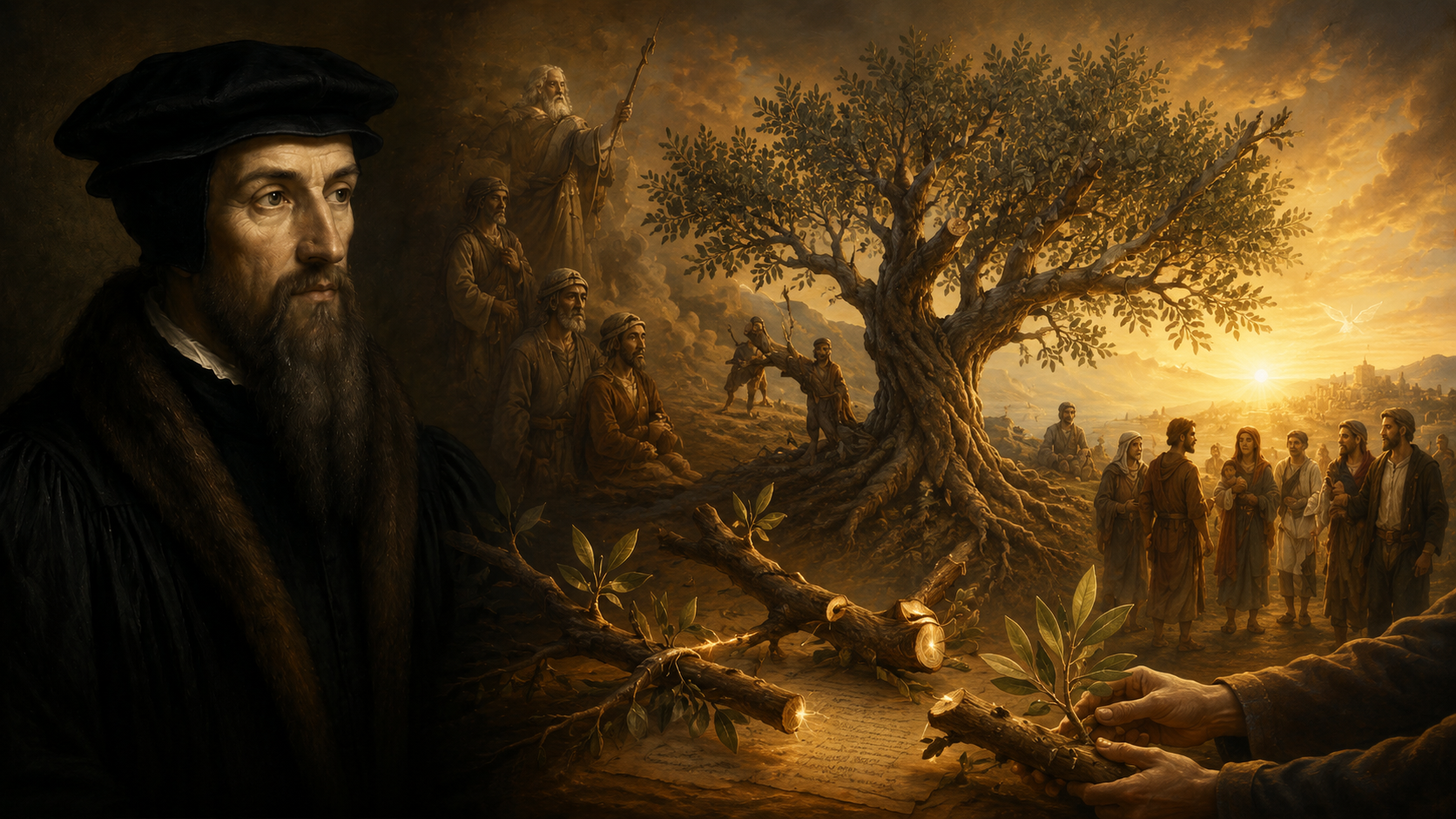
All of these points where Calvin is confused are addressed by Paul in Romans 11 in the picture of the olive tree—a picture he draws together from many places in the Old Testament.
1) The Olive Tree in Jeremiah
The image of God’s people as a plant pops up in a few places in the Old Testament (e.g. the vine in Psalm 80:8-19 or vineyard in Isaiah 5:1-7).
But Paul’s picture of God’s people as an olive tree is probably most directly drawn from Jeremiah 11. Paul’s other striking image of God as the potter back in Romans 9 was also drawn from Jeremiah. Here’s what the prophet says:
16 The LORD once called you ‘a green olive tree, beautiful with good fruit.’ But with the roar of a great tempest he will set fire to it, and its branches will be consumed. 17 The LORD of hosts, who planted you, has decreed disaster against you, because of the evil that the house of Israel and the house of Judah have done, provoking me to anger by making offerings to Baal. (Jeremiah 11:16-17)
In this image both God and Israel have agency:
- God planted Israel so as to bring good fruit.
- Israel did evil resulting in disaster.
2) The Olive Tree in Romans 11
Jeremiah’s use of the olive tree illustration is consistent with everything Paul says in Romans 9-11:
- Salvation is all of God: he elects sinners in Christ purely from his grace, declares forgiveness in Christ universally to all, and gives faith to his elect through hearing this universal proclamation.
- But failing to receive salvation is entirely due to human sinfulness: rebellious human beings reject God’s grace, refuse to listen and submit to the Gospel, and resist God’s work in Christ for them through their own unbelief.
Paul doesn’t say how these two things fit together logically. But he does say these two things.
In Romans 9-10, Paul has defended God sending the Gospel to Gentiles after the Jews rejected this. This was not a failure of God’s Word, but a judgment on their unbelief that even Moses warned them would come. But in Romans 11, Paul says that even this turning away from Israel is intended with the hope that it may lead to the eventual salvation of those who have already rejected the Gospel:
13 Now I am speaking to you Gentiles. Inasmuch then as I am an apostle to the Gentiles, I magnify my ministry 14 in order somehow to make my fellow Jews jealous, and thus save some of them. (Romans 11:13-14)
Paul argued in Romans 9 that even the hardening of unbelievers has a positive purpose. God hardened Pharaoh in order to drive the proclamation of the Gospel to a global audience for the salvation of others. Now in Romans 11 Paul comes full circle: even God’s response to unbelief is ordered toward the positive intention that those who have already rejected the Gospel may yet be saved.
In summary, here is what Paul is teaching through the olive tree illustration:
God does not desire anyone to perish. God reveals his heart to us in the Gospel: Jesus died for everyone, because God wants everyone to be saved. So what truly matters is not some eternal decision behind that Gospel, but people receiving the Gospel and responding to it—and as long as the Gospel is being preached, there is always hope for anyone who hears it.
17 But if some of the branches were broken off, and you, although a wild olive shoot, were grafted in among the others and now share in the nourishing root of the olive tree, 18 do not be arrogant toward the branches. If you are, remember it is not you who support the root, but the root that supports you. (Romans 11:17-18)
The Gentiles only have life because of the root: God’s promise to Abraham, fulfilled in Christ, delivered through the Gospel. Paul continues:
19 Then you will say, “Branches were broken off so that I might be grafted in.” 20 That is true. They were broken off because of their unbelief, but you stand fast through faith. So do not become proud, but fear. 21 For if God did not spare the natural branches, neither will he spare you. (Romans 11:19-21)
Paul says people are not excluded because they are worse, and you Gentiles are not included because you are better. This directly contradicts Calvin’s doctrine of “reprobation”. Paul says exclusion happens purely because of unbelief. And the branches that are grafted in cannot simply presume that they are safe because of a hidden decree of God. Their inclusion is sustained purely through trusting in the Gospel. If they stop trusting the Gospel, they also will be excluded.
This is precisely what Paul drives home with his explanation in vv. 22-24:
22 Note then the kindness and the severity of God: severity toward those who have fallen, but God’s kindness to you, provided you continue in his kindness. Otherwise you too will be cut off. 23 And even they, if they do not continue in their unbelief, will be grafted in, for God has the power to graft them in again. 24 For if you were cut from what is by nature a wild olive tree, and grafted, contrary to nature, into a cultivated olive tree, how much more will these, the natural branches, be grafted back into their own olive tree. (Romans 11:22-24)
Again, Paul is consistently asymmetrical. God’s severity is experienced by those who fall away due to their own unbelief. But God’s kindness is experienced by those whom he grafts into the tree.
Salvation is all from God.
Damnation is all from us.
God genuinely wants all people to hear the Gospel. And that includes you, reading this. He wants you to hear the Gospel because it is through this Gospel that he grafts you into Christ and keeps you there by faith.
Those who reject the Gospel do so by their own agency, not because God predestined them for damnation. You are not predestined for damnation.
What does the Gospel say to you? Christ died for you. Your sins are forgiven. You belong to him.
So do not look behind Christ for a hidden decree. Do not look inside yourself for proof that you are elect. Look at Christ. Hear his Gospel. Receive his gifts.
And this is why God has given you the church. The church is the place where Christ has promised to give you his Gospel, graft you into himself, and preserve you by his Word and Sacraments.
So, come and join us as we receive this Gospel together: